Bedroom Ideas
Sharing a Small Bedroom Without the Friction
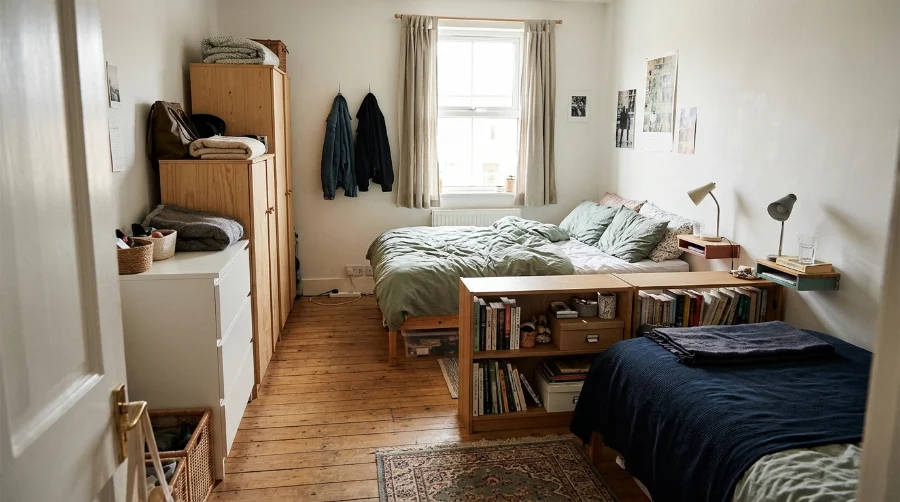
Two people can share a small bedroom comfortably, but the room has to be planned for two sets of habits. The usual problems are not solved by more storage. They…
A reading nook in a small bedroom does not need a whole corner to itself. It needs a seat, a light and somewhere to put a book down. When those three things are in…
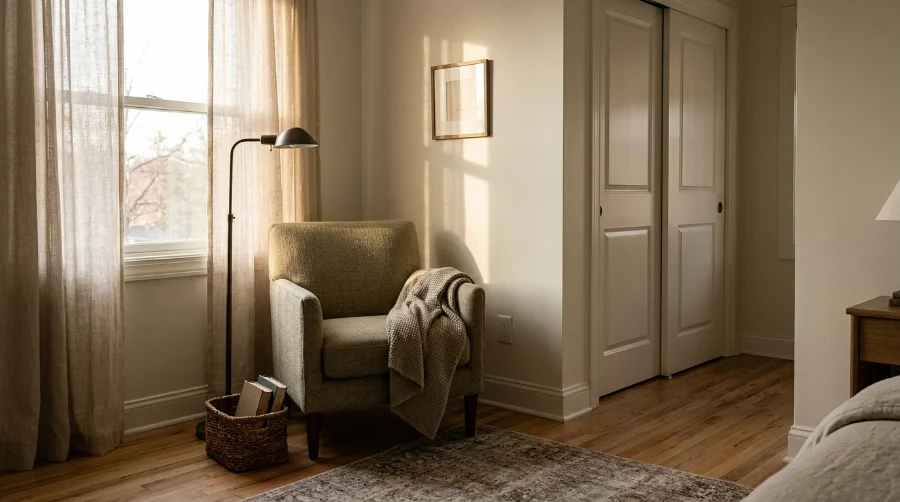
A reading nook in a small bedroom does not need a whole corner to itself. It needs a seat, a light and somewhere to put a book down. When those three things are in the right place, a narrow gap beside a window or the foot of a bed can become a spot people actually use.
Look at the room and notice where there is a pocket of space that is not part of the main walking route. The area beside a window, the end of a bed or the strip next to a wardrobe may work. Avoid placing a chair where someone has to step around it to reach the closet.
If two people share the room, choose a spot that does not block the other person's side. A nook that causes friction will be used less than one in a slightly less attractive but calmer position.
A full armchair can overwhelm a small bedroom. A compact chair with a cushion, a narrow accent chair or a small stool with a back may be enough. Check the width and depth, then think about whether the sitter needs room to stretch their legs.
Measure the gap before buying anything. A chair that fits on paper but opens into the doorway will be moved within days. If space is very tight, a foldable chair can be brought out when needed and stored behind the door afterwards.
Reading needs focused light. A small floor lamp with an adjustable head or a wall-mounted light beside the chair works better than the room's main ceiling fixture. A warm bulb is usually more comfortable for evening reading than a bright cool one.
In a shared bedroom, a lamp with a shade that directs light downward allows one person to read while the other sleeps. Place the light so it falls on the page rather than into the eyes. If the chair sits beside a window, daytime reading may need no lamp at all.
A tall bookcase in a small bedroom can make the room feel narrower. A shallow shelf beside the chair, a small basket on the floor or a single floating shelf is often enough. Keep only the books currently being read or those likely to be picked up again.
Stacking a few books on the floor beside a chair looks casual, but the stack tends to spread. A small basket gives the same relaxed feeling with a clear boundary. Refill it from the main book storage elsewhere in the home.
One cushion, one throw and perhaps a low rug can change how a chair feels. Choose fabrics that can be washed or shaken out easily, because a reading corner collects dust. A throw folded over the arm of the chair is more practical than several pillows that have to be moved before sitting down.
Keep the layers few. In a small room, too many soft items start to look like a pile. One comfortable seat with one cushion is usually enough to make the space inviting.
A reading nook should not become storage for everything that has nowhere else to go. Give the nearby surface one purpose: a book, a lamp and perhaps a cup. If post, clothes or bags start collecting there, the nook will stop feeling like a place to sit.
Choose a small side table or a wall shelf rather than a full table. A surface of around 12–16 inches (30–40 cm) across can hold what is needed without becoming a dumping ground. When the nook is not in use, clear it in a few seconds.
When two people share a bedroom, a reading nook needs a few extra boundaries. Agree whose side of the room it belongs to and when it is likely to be used. If one person reads late, choose a lamp that can be switched off quietly and a chair that does not creak on the floor.
Keep the book basket personal rather than shared. A shared basket fills with items nobody is currently reading and becomes clutter. Each person can keep one or two books in their own small spot, with the rest stored elsewhere in the home.
If the nook sits beside the other person's sleeping area, a small screen or the back of a chair can soften the light. It does not need to block the whole room. The aim is to let one person read without making the other feel that the bedroom has become a living room.
Another mistake is copying a nook from a much larger room. A small bedroom version will be simpler, and that is fine. The value is in having a place to sit, not in reproducing a photograph.
Place a comfortable chair in a quiet gap, add a lamp that lights the page and put a small basket beside it for books. Use the corner for a week before adding anything else. If it gets used, add a cushion or a throw. If it does not, move the chair and try another spot.
A good reading nook in a small bedroom is not a grand redesign. It is a deliberate little space where the things you need are already within reach. That simplicity is what makes it inviting at the end of a long day. If the corner stays clear and the light works, the nook has done its job. It does not need to look like anyone else's idea of a reading corner.
Guides that pair well with this one.
Two people can share a small bedroom comfortably, but the room has to be planned for two sets of habits. The usual problems are not solved by more storage. They…
A spare room rarely turns into a guest room by accident. It starts with a bed and a lamp, then a box of out-of-season clothes goes in, followed by a suitcase, a…
Choosing storage for a small bedroom is different from organizing one that is already furnished. The decisions made at the point of purchase shape how the room…