Bedroom Ideas
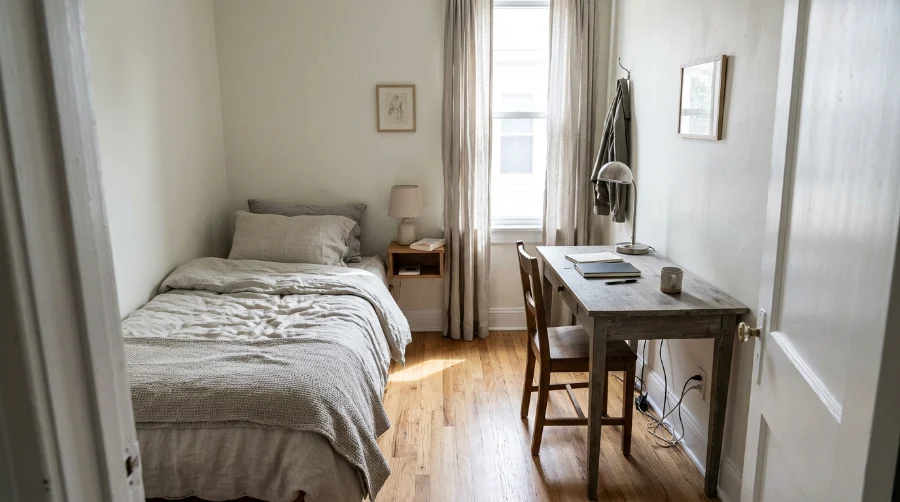
Fitting a Desk and Bed Into One Small Bedroom
Fitting a bed and a desk into one small bedroom means asking a single room to do two jobs that normally claim separate floors. A bed needs access along at least one…
Choosing storage for a small bedroom is different from organizing one that is already furnished. The decisions made at the point of purchase shape how the room…
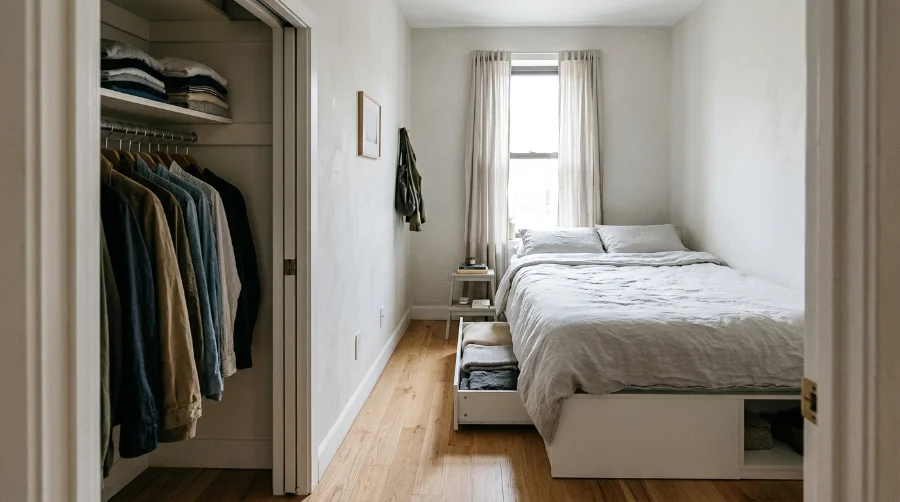
Choosing storage for a small bedroom is different from organizing one that is already furnished. The decisions made at the point of purchase shape how the room works for years. A wardrobe that is too deep, a chest that blocks a door or a bed with no space underneath can quietly cost valuable room. Thinking through a few practical questions before buying avoids expensive mistakes.
Start with measurements rather than with furniture catalogues. Record the room dimensions, the position and swing of the door, the window, the radiator and any built-in features. Then measure the route from the door to the bed and to the closet, because that path must stay clear.
Note the ceiling height too. Tall storage can use vertical space in a small room, but only if it fits without touching the ceiling or blocking light. Take the measurements with you when shopping, or keep them on a phone, so a promising piece can be checked on the spot.
Storage depth is often wasted in a small bedroom. A standard wardrobe is roughly two feet deep, but many households store mostly folded clothes and hanging items that need far less. A shallower wardrobe frees floor area and makes the room feel less crowded, provided it still holds what the household owns.
Deep drawers and chests have the same issue. They hold a great deal, but the items at the back are hard to reach and the furniture projects further into the room. Where floor space is tight, choose shallow units that line a wall rather than deep ones that jut out.
In a small room, the bed is the largest object and its underside is often wasted. A bed with built-in drawers adds storage without a separate footprint. A divan base with drawers, or a raised frame with boxes underneath, can hold bedding, out-of-season clothes or luggage.
Check the clearance needed to open the drawers or lift the bed. A storage bed in a very tight room may be impossible to use if there is no space to pull a drawer out. Also consider cleaning underneath: a bed that lifts easily is more useful than one that requires removing everything to reach the floor.
Walls above eye level are the most underused storage in a small bedroom. A shelf above the wardrobe, a rail high on a wall or a tall narrow unit beside the door can hold items used less often. Keep the lowest and most accessible areas for daily things, and reserve high storage for bedding, spare linens or luggage.
Avoid fitting so much that the room feels closed in. Several wall shelves with open gaps look lighter than one full-height wall of cupboards. Leave some plain wall visible so the eye has a break, particularly if the room is short on natural light.
Before choosing a wardrobe, look at the clothes that will go into it. A household that mostly hangs clothes needs a long hanging rail and a shorter section for folded items. Someone who keeps most items folded needs more shelves and fewer rails. A wardrobe with the wrong internal layout wastes space even when it looks the right size.
Choose slim hangers to fit more on a rail, and consider a second rail where the wardrobe is tall enough. Adjustable shelving is useful because it can change as the household's needs change. A fixed layout that suits today's wardrobe may not suit one in two years.
Furniture that does two jobs sounds ideal in a small room, but not all of it works in practice. A bench with storage at the foot of the bed is useful if the lid is easy to lift and the bench does not narrow the walking route. A bedside table with a drawer is helpful; one with three cramped compartments is not.
Be wary of pieces that promise storage but compromise both functions. A storage ottoman that must be emptied before anyone can sit on it is not genuinely seating. Ask whether each function still works when the other is in use.
A common buying error is choosing furniture that fits the room on paper but cannot be opened. Check the space needed for a wardrobe door to swing, a drawer to extend and a bedside drawer to pull out. In a tight room, sliding doors can save the swing space, though the rail needs occasional cleaning to run smoothly.
Also check that a new piece does not block a socket or a light switch. These small details are easy to miss in a shop and frustrating to discover at home.
Tall storage in a bedroom should be stable. Anchor tall units to the wall, especially where children climb or where the home is prone to movement. Check that shelves are fixed at sensible heights so heavy items are not stored above head level.
Where children share the room, store anything heavy or fragile where it cannot be pulled down. Soft-close drawers and rounded corners reduce minor injuries in a space that is used in the dark.
Storage in a small bedroom is touched constantly, so the finish matters more than it first appears. Open shelving collects dust quickly and needs regular wiping, while closed cupboards hide it but must be opened to be checked. Light-coloured surfaces make a small room feel brighter and show less visibly in dim light, though they mark more easily. Choose materials that can be wiped clean without special products, and avoid intricate detailing that traps dust in a compact space where cleaning is awkward.
The best storage for a small bedroom is not necessarily the largest or the most elaborate. It is the piece that fits the room, matches how the household keeps its belongings and leaves enough space to move comfortably. Measure first, be honest about what needs storing, and favour accessible storage over hidden capacity. A well-chosen unit makes a small room easier to live in every day.
Guides that pair well with this one.
Fitting a bed and a desk into one small bedroom means asking a single room to do two jobs that normally claim separate floors. A bed needs access along at least one…
A spare room rarely turns into a guest room by accident. It starts with a bed and a lamp, then a box of out-of-season clothes goes in, followed by a suitcase, a…
Two people can share a small bedroom comfortably, but the room has to be planned for two sets of habits. The usual problems are not solved by more storage. They…