Bedroom Ideas
A Small Wardrobe That Works Without Built-Ins
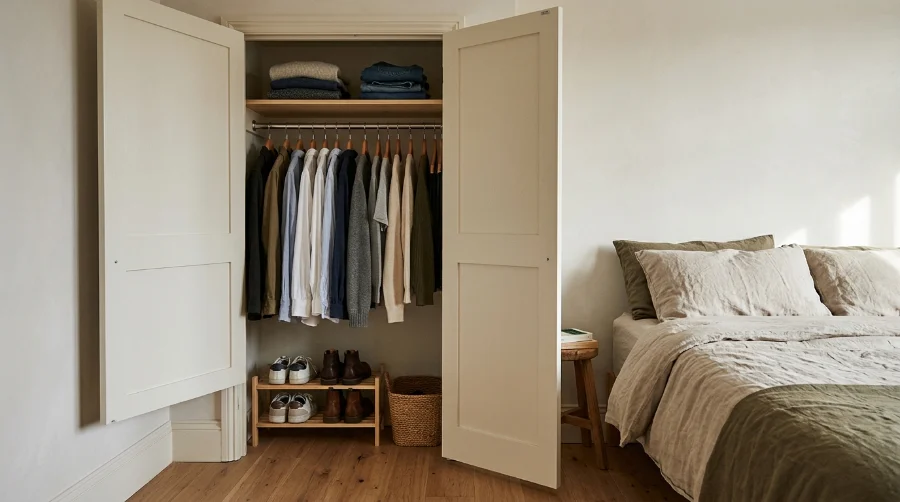
A small wardrobe becomes difficult when the way it is built does not match the clothes it holds. Many wardrobes give most of their space to a hanging rail and very…
The point of a child's clothes storage is not tidiness for its own sake. It is the quiet goal of a child getting dressed without an adult fetching everything first…
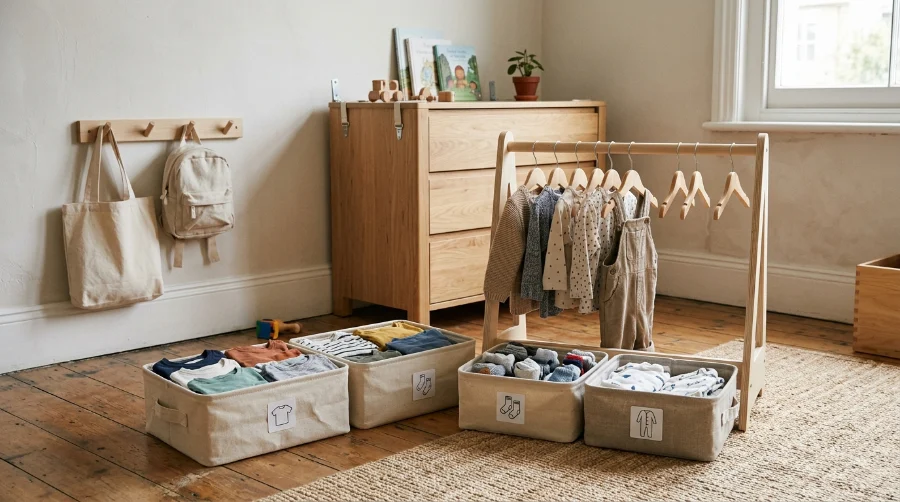
The point of a child's clothes storage is not tidiness for its own sake. It is the quiet goal of a child getting dressed without an adult fetching everything first. That goal changes what belongs in the bedroom and where it sits. A rail at adult eye level may look neat and keep garments uncreased, but it fails the moment the child cannot reach the hanger. Storage for children is judged by what they can reach and put back, not by how it looks when the door is shut.
Start from the child's height rather than the room's dimensions. Kneel or crouch at the child's eye level and look at the storage as they will see it. Anything above shoulder height is effectively out of reach for daily use, even if the child can stretch to it on tiptoe.
A low rail or a shelf at roughly chest height works for most pre-school children, though the exact figure depends on the individual. Hooks fixed at a height the child can reach without jumping are useful for the next day's outfit and for bags. Leave a clear gap between the top of a stored pile and the shelf above, so items can be put back without shoving.
Reserve the hardest-to-reach places for things the child never handles alone: spare bedding, out-of-season clothes in sealed bags, or occasional dress-up items. The everyday layers should live at levels a child can actually use. A system that looks beautiful but requires a step stool for every sock is not a child's system at all.
Both systems have a place, and the choice depends on what is being stored. Low, wide bins are forgiving: a child can drop folded clothes into them without needing to hang anything on a hanger, and the open top makes the contents visible. They suit t-shirts, leggings, socks and pyjamas.
A hanging rail keeps shirts and dresses crease-free and makes a single garment easy to select. The difficulty is the hanger itself. Small children often cannot unhook a hanger from a rail or slide a garment off it, so a rail works best with child-size hangers and only a few items, spaced apart.
A mixed approach usually works better than choosing one. Keep the garments that are easiest to pull on in open bins at floor level, and reserve a short, low rail for the few items that genuinely need to hang. Bins with cut-out handles are easier for small hands than smooth-sided boxes.
Watch the depth of any container. A bin that is too deep hides the clothes at the bottom and becomes a place where things disappear. Shallow bins stacked two high often work better than one large tub, provided the upper one can be lifted down safely.
There are two useful ways to sort a child's clothes, and they suit different ages. Grouping by garment type means all socks in one place, all tops in another. This is simple to maintain and works well once a child understands categories.
Grouping by outfit means a complete set — top, bottoms, socks and sometimes underwear — lives together in one bin or on one hook. For a younger child this removes the decision-making that leads to a mismatched or inappropriate combination. It also makes it possible for someone else to hand over a single bag when getting dressed in a hurry.
The outfit approach needs a little more work at laundry time, because each set has to be put back together. A compromise is to keep a small number of complete outfits ready in a designated spot while the rest of the wardrobe is sorted by type. As the child grows and starts making choices, the balance can shift toward type-based sorting.
A label only helps if the child can read it. For pre-readers, use a system based on shape, color or picture. A photograph of the garment taped to the front of a bin, or a simple sticker showing socks or shirts, tells the child where things belong without requiring letters.
Color-coded bins work well when each category has a distinct color and the same color is used on the shelf or drawer where it belongs. Consistency matters more than the scheme itself. Introducing a second color for the same category halfway through teaches nothing.
Avoid labels that sit only on the top edge of a container, because the contents change as items are removed and the label may end up facing the wall. Put the marker on the front where it stays visible at the child's eye level. In shared rooms, a name or photograph helps each child recognise their own section.
A wardrobe that holds clothes for every season overwhelms a small child. Items buried at the back are forgotten, and the bins at the front become overfilled because nothing is ever removed. Rotation keeps the available choice small and matched to the weather.
Store out-of-season clothes elsewhere — in a labelled box on a high shelf, under the bed in a sealed container, or in another room's storage. Bring back only what fits at the time. Children grow at uneven rates, so a garment kept for a future season may no longer fit when that season arrives.
A quick way to check fit is to notice which items are consistently left untouched and which are repeatedly asked for. Clothes that are too tight, too short or uncomfortable should leave the accessible bins rather than sitting there as a daily reminder of a poor fit. Passing them on keeps the system honest.
Anything tall or top-heavy needs anchoring. Chests, bookcases and narrow shelving units can tip when a child climbs or pulls on a drawer, so fix them to the wall with brackets rated for the purpose. This applies even to furniture that looks stable.
Keep heavy items off high shelves and out of overhead containers. A bin placed above a bed or a changing area can become a hazard if it is knocked down. Store the lightest things at the top and the heavier folded clothes low down.
Check that bins and baskets have no sharp edges, that drawer stops prevent units sliding out, and that any hanging bag or tie is out of reach of a cot or bunk bed. Avoid containers with tight lids that a child might seal themselves inside. Corded items such as blind pulls should be kept away from the storage area entirely.
No children's storage arrangement stays correct for long. The child who could once reach the lower shelf begins to use the top one, and the outfit bins that worked at four feel limiting at seven. Plan for changes rather than trying to design a single system for a decade.
Revisit the heights once or twice a year, moving the everyday items up or down as needed. Change the labels from pictures to words when reading begins, which gives the child a new reason to use the system. Introduce a small amount of choice, such as two outfit bins instead of one, when the child is ready to decide.
Involve the child in the change. A system a child helped to fill is more likely to be put back correctly than one imposed from above. The aim is not perfect folding but a route from dirty laundry to a place the child can reach and understand, repeated day after day.
Getting dressed independently is built from small, repeatable actions. When a child can see the choices, reach the containers and return an item without help, the storage is doing its job. Everything else is decoration.
Guides that pair well with this one.
A small wardrobe becomes difficult when the way it is built does not match the clothes it holds. Many wardrobes give most of their space to a hanging rail and very…
A small bedroom has to do more than sleep. It may also hold clothes, a desk, a place to sit and the things you want within reach at night. The trick is not to find…
Fitting a bed and a desk into one small bedroom means asking a single room to do two jobs that normally claim separate floors. A bed needs access along at least one…