Bedroom Ideas
Choosing Bedroom Storage That Fits a Small Room
Choosing storage for a small bedroom is different from organizing one that is already furnished. The decisions made at the point of purchase shape how the room…
Fitting a bed and a desk into one small bedroom means asking a single room to do two jobs that normally claim separate floors. A bed needs access along at least one…
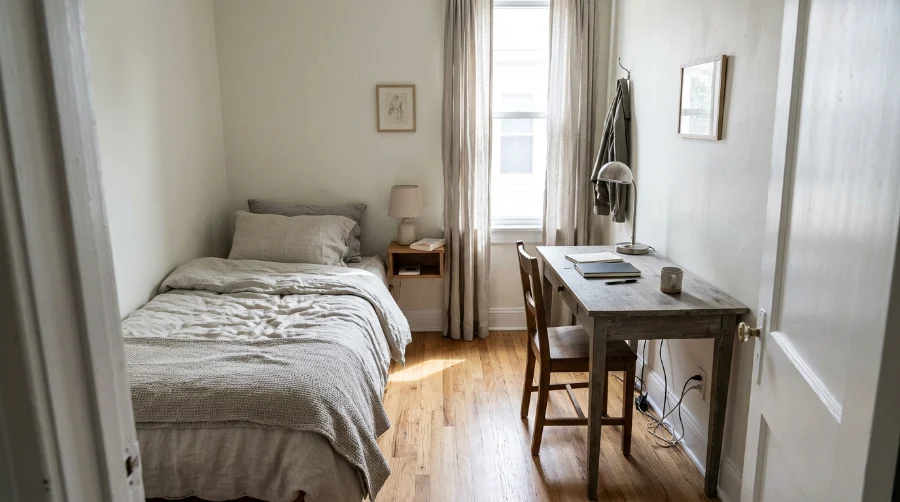
Fitting a bed and a desk into one small bedroom means asking a single room to do two jobs that normally claim separate floors. A bed needs access along at least one side and clear space to make it; a desk needs a chair that can slide back and a surface that stays usable from the moment someone sits down. Neither piece can simply be pushed against a wall and forgotten. The arrangements that work treat both as competing priorities from the outset, then give each one the clearance it needs before anything else is added.
Good layout decisions begin with measurements taken on the actual floor rather than guessed from memory. Record the width and length of the room, then note where the door sits, which way it opens, and the position of each window. An inward-opening door can claim a surprising arc of floor, and a desk placed inside that arc will either stop the door from opening fully or have to be moved later.
Mark out the walking clearance needed between the bed and the desk. Roughly 60 to 75 centimetres usually lets a person pass without turning sideways, though a genuinely tight room may force a narrower route. Measure whether that route stays clear once the chair is pulled out, because a chair that opens into the only walkway turns an apparently workable layout into an obstacle course.
Note fixed features as well: radiators, built-in cupboards, the height of the window sill, and where the sockets sit. These details often decide where the desk can go more firmly than the empty wall does. A socket on the wrong wall can mean a cable running across the room, which is awkward in a space that is already short of floor.
The bed drives most of the other decisions. In a room that must serve as both bedroom and study, a double bed can take more floor than the desk can spare once access and chair space are accounted for. A single or small double often frees enough room for a work surface that is genuinely usable rather than a token shelf. If the room is rarely occupied by two people, the smaller bed is usually the better trade.
Bed frames with drawers underneath can help when wardrobe space is limited, but check that the drawers can open on the side where the desk or chair will sit. A deep frame also raises the mattress, which can make a low window sill feel cramped.
For the desk, a depth of about 50 to 60 centimetres is enough for a laptop, notebook and a lamp without eating the room. Wider is useful only if there is a second activity to support; a 90 to 120 centimetre top suits most single-user setups. A wall-mounted or folding top can reclaim floor when work hours are over, though it needs solid fixing and a clear wall. Deep executive desks rarely earn their space in a bedroom.
Desk orientation changes how the room feels and how well it works. Three options dominate, and each solves a different problem.
A wall-facing desk gives a quiet, predictable background and keeps the work area visually separate from the bed. It suits tasks that need concentration and helps the sleeping end of the room feel distinct. The trade-off is a closed-in feeling, so check that daylight or a good lamp reaches the surface, and remember that the chair will project into the room rather than tuck against a wall.
Daylight makes a desk pleasant, but a window directly in front of or behind the screen can cause glare or a dark silhouette. Side light is usually easier to manage than light from straight ahead. If the only workable position faces the window, a sheer blind can soften bright hours without making the room feel sealed off.
Placing the desk at right angles to the window often gives the best of both arrangements: natural light from the side, a view that is not a blank wall, and less reflection on the screen. This position also lets the chair sit beside the desk rather than in the middle of the room, provided the bed leaves enough space.
A desk is only usable if the chair can move. Allow roughly 75 to 90 centimetres behind it so the chair can slide back and a person can stand up without shuffling. That zone is easy to forget when furniture is drawn on paper, yet it is the detail that decides whether the desk works in practice.
Where space is tight, a stool that tucks fully beneath the top or a chair on smooth wheels reduces the clearance needed. Check that the chair back does not land in the path to the bed or the wardrobe when someone pushes it in. A swivel chair is convenient, but a fixed chair that slides cleanly can demand less room.
A single ceiling light rarely serves both a bed and a desk well. Brighter, cooler light supports work; softer, warmer light suits the end of the day. Layering them lets one room shift character without moving furniture.
Give the desk its own adjustable lamp, positioned so light falls on the page or keyboard without reflecting off the screen. A lamp that clamps to the desk edge saves surface space. At the bed, a low, shaded light is enough for reading and does not flood the working area when someone else is still using it.
Keep the general light even rather than placing one strong bulb in the center, which can leave the desk in shadow behind a person seated at it. Where the desk faces the wall, a light mounted above and slightly in front of the work position prevents the user's own shadow from falling across the surface.
In a small room, loose cables read as clutter far more than they would in a spacious one. Place the desk near an existing socket so leads do not have to stretch across the floor. A single switched power strip kept on the desk or clamped beneath its back edge gathers several plugs in one place and can be turned off at the end of the day.
A shallow cable tray or adhesive channel along the rear of the desk hides leads without any drilling, which suits rented rooms. Group the monitor, charger and lamp leads together and keep them clear of the chair wheels. Avoid running cables under the bed, where they can be crushed by the frame or become a trip hazard in dim light.
There is a point at which a bedroom stops being a sensible home for a desk. If the workstation is used every day for long periods, and the equipment spreads across the bed or blocks the wardrobe, the arrangement is asking the room to absorb more than it can. The sign is not the size of the furniture but whether the space ever settles back into a place for rest.
Alternatives include a corner of the living room screened by a shelf, a dining table used at set hours, a wide landing, or a shallow cupboard converted into a work recess. Each keeps the bedroom simpler and gives work a clearer boundary. A desk used for occasional letters and bills is a reasonable guest in a bedroom; a full-time workstation usually needs its own territory.
Measure the floor, give the chair its space, decide which way the desk faces for light, and remove anything that does not earn its place. When those basics are right, a small bedroom can hold both functions without either one taking over.
Guides that pair well with this one.
Choosing storage for a small bedroom is different from organizing one that is already furnished. The decisions made at the point of purchase shape how the room…
A small bedroom has to do more than sleep. It may also hold clothes, a desk, a place to sit and the things you want within reach at night. The trick is not to find…
The point of a child's clothes storage is not tidiness for its own sake. It is the quiet goal of a child getting dressed without an adult fetching everything first…