Kitchen Organization
Kitchen Cabinets - Why the Same Mess Returns
Most kitchen cabinets are not short of space; they are short of a plan. When a cupboard becomes hard to use, the usual response is to buy another organizer or tip…
The cupboard under the kitchen sink is often the least ordered space in the room. It holds cleaning products, spare cloths, plumbing parts, and a few things nobody…
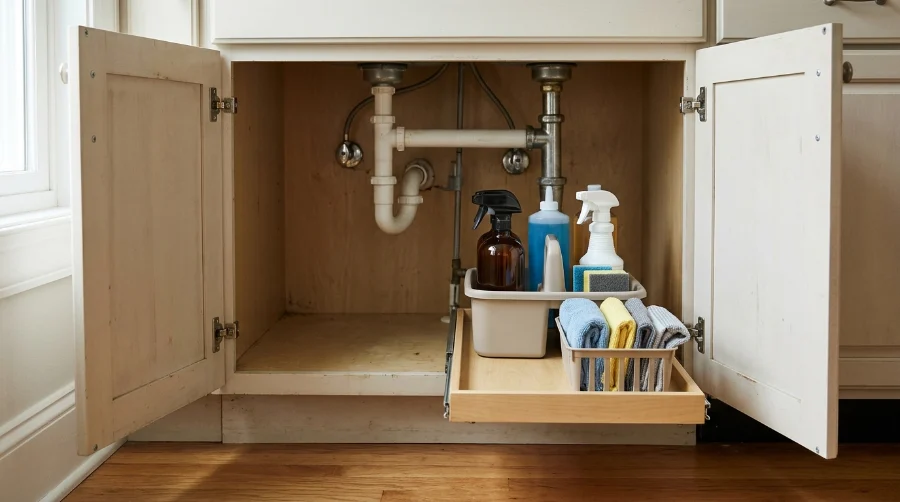
The cupboard under the kitchen sink is often the least ordered space in the room. It holds cleaning products, spare cloths, plumbing parts, and a few things nobody remembers putting there. Organizing it well is less about adding bins and more about working around the pipes and keeping damp items away from dry ones.
Before clearing anything out, look up. Most under-sink cupboards contain a drain pipe, water valves, and sometimes a waste disposal unit or a filter. These fittings are not obstacles to be hidden; they need to stay accessible for repairs and inspections. Anything stored in front of a valve will have to be removed at the worst possible moment.
Note where the pipes enter the cupboard and how much clear space is left at the sides. Storage should fit around them, not cover them. A bin placed directly beneath a joint may collect water if a connection drips, turning a small leak into damaged packaging and a larger mess.
Check for existing signs of moisture: a musty smell, dark marks on the wood, or a soft patch on the cupboard base. Deal with the cause before organizing. A tidy cupboard with a slow leak is still a problem, and cardboard bins will hide the damage until it is serious.
This cupboard usually holds both clean and used items, which is the source of much of its disorder. Separate them into two clear groups: products used to clean, and items being stored. Spare cloths, bin liners, and dishwasher tablets belong with cleaning. Leftover building materials, spare taps, and old containers belong elsewhere if possible.
Keep cleaning products together in one container that can be lifted out in a single movement. When the whole group comes out, the cupboard can be wiped and the bottles checked. A loose collection of bottles at the back of the cupboard is impossible to manage without taking everything out one by one.
Store dry items such as spare cloths and gloves in a different container from spray bottles. A leaking bottle ruins a stack of cloths quickly. Keeping the two groups apart limits the damage and makes it obvious which container has a problem.
Deep bins look efficient but waste space around pipes. Shallow trays and narrow bins that slide in and out work better under a sink. Measure the width, depth, and height of the free space before buying anything, and check that a bin can be removed without lifting it over the pipe.
A pull-out tray is useful if the cupboard is deep, because it brings the back of the cupboard into view. If the fittings are not available for the existing cabinet, a simple shallow box on rails can serve the same purpose. Anything that must be reached by feel will eventually be forgotten.
Avoid sealed plastic tubs for anything that may be damp. Air needs to circulate, particularly around cloths and sponges. An open bin or a ventilated basket is easier to keep fresh.
Cleaning products should stay in their original containers with labels intact. Decanting into unmarked bottles makes it hard to know what a product is, and mixing unknown liquids is dangerous. If a product must be transferred for safety reasons, label it clearly with its name and keep the original instructions.
Never store cleaning products next to food or utensils, even for a short time. Under-sink cupboards sometimes hold spare food items in mistake. Keep food elsewhere entirely, and check the cupboard occasionally for anything that does not belong.
If children are in the home, fit a lock or a high-level catch. A cupboard under a sink is at exactly the height a child can reach, and colourful bottles are tempting. A lock that is inconvenient for adults will not be used, so choose one that can be opened quickly but cannot be managed by a small child.
A musty smell usually means moisture and poor airflow. Wipe the cupboard base dry, remove any wet cloths, and leave the door open for a while on a dry day. Check the pipe joints and the seal around the drain. If the smell returns after cleaning, the source is likely to be a slow leak or a trapped damp item.
Keep only a small number of cloths under the sink at any time. A pile of damp cloths at the back of a cupboard will smell within days. Wash and dry them before putting them back, and make a habit of checking the group when the cupboard is tidied.
Do not mask a persistent smell with a stronger product. Find the cause first. A fragranced spray may hide the problem for a day while a leak continues to damage the cupboard.
Do not treat this cupboard as a general store for plumbing spares unless there is a clearly labelled container for them. A few spare washers and a tape measure are useful; a full toolkit is not. Keep large tools somewhere they can be reached without emptying the cupboard.
Do not overfill the space. A cupboard packed to the door cannot be inspected, and nobody will tidy something that requires moving everything twice. Leave a little room so the daily spray bottle can be put back without rearranging the shelf.
Finally, do not store products that should be kept dry in a cupboard that gets damp. Cardboard packaging softens, labels peel, and metal lids rust. If the space is prone to moisture, choose plastic containers and check them regularly.
A well organized under-sink cupboard has one clear quality: everything can be seen and reached quickly. Keep the pipes accessible, group cleaning products in one lift-out container, and give damp items their own space. When a leak or a missing bottle does happen, the problem can be dealt with in minutes rather than turning into a full afternoon of sorting.
Guides that pair well with this one.
Most kitchen cabinets are not short of space; they are short of a plan. When a cupboard becomes hard to use, the usual response is to buy another organizer or tip…
Making a hot drink is a small sequence repeated many times a day: reach for a cup, add coffee or tea, boil water, sweeten, stir, and clean up. When those six steps…
A freezer is easy to forget until something is lost at the back of it. Unlike a fridge, it hides food in solid blocks and frost, and a bag of vegetables can be…