Kitchen Organization
A Coffee and Tea Station Built Around Your Routine
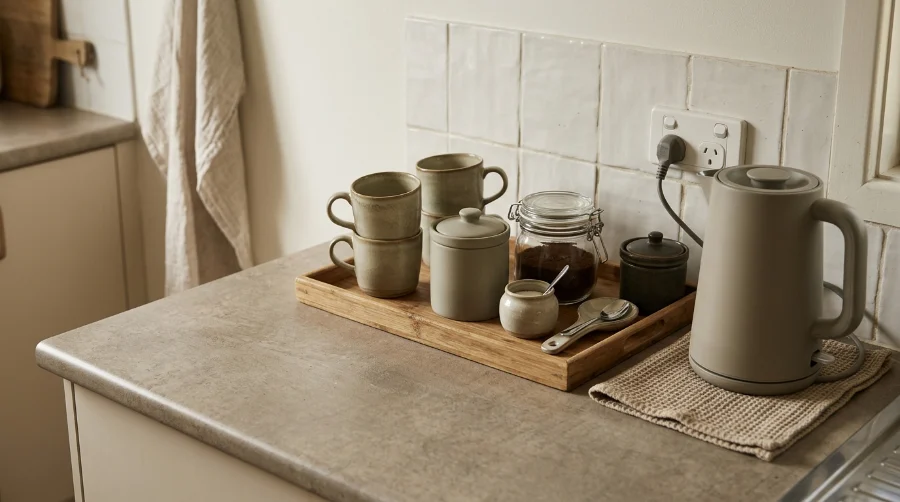
Making a hot drink is a small sequence repeated many times a day: reach for a cup, add coffee or tea, boil water, sweeten, stir, and clean up. When those six steps…
Counter clutter is rarely caused by owning too many things. It appears when items have no reliable home, so the counter becomes the default. Clearing it…
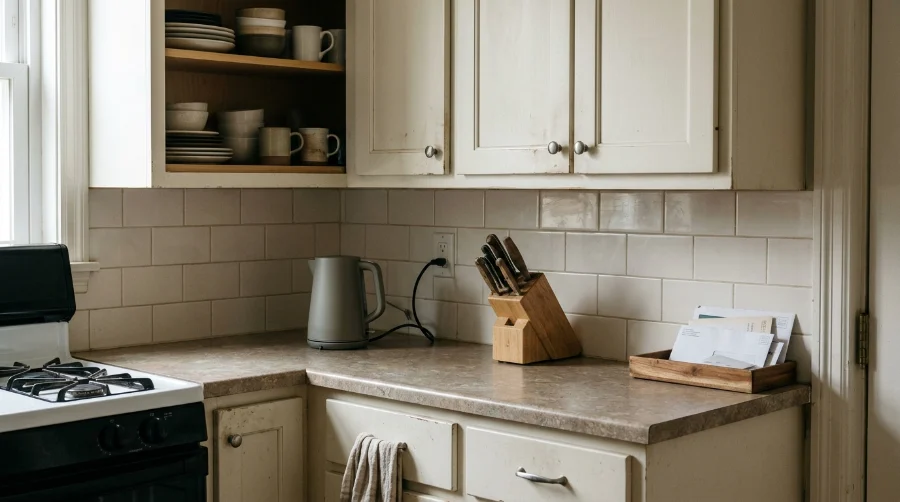
Counter clutter is rarely caused by owning too many things. It appears when items have no reliable home, so the counter becomes the default. Clearing it successfully means giving those items somewhere sensible to live, not simply moving them into a drawer that is already full.
Stand in the kitchen and look at what is on the worktop. Most items fall into three groups: things used daily, things used weekly, and things that only appear on the counter because there is nowhere else for them. The third group is the one to deal with first.
Daily items such as a kettle, a knife block or a fruit bowl may deserve to stay. Weekly items can often move into a cupboard or a nearby drawer. Anything that has been sitting untouched for weeks should be assigned a proper home elsewhere or removed from the kitchen altogether.
Small appliances are the biggest source of counter clutter in many kitchens. Ask how often each one is used. A toaster or coffee maker that is used every morning earns its place. A slow cooker used twice a year does not.
For appliances that stay out, keep the area around them clear enough to use them safely. For the rest, a cupboard with a pull-out shelf works better than a high shelf that requires a step ladder. If cupboard space is limited, a single open shelf in an adjoining room can be more practical than stacking appliances precariously above the worktop.
Wall space can absorb a surprising amount, but it needs restraint. Open shelves are convenient for everyday dishes and a few jars, yet they collect dust and make the room look busy. One or two shelves used well are better than a full wall of them.
Hooks under a shelf can hold mugs or small utensils, provided they do not hang over the work area at head height. A rail with a few hanging items is useful; a rail packed with every gadget you own becomes visual noise. Leave some empty wall so the eye can rest.
Paper, pens, keys and takeaway menus often land on the counter because the household has no other drop-off point. A shallow drawer near the entrance to the kitchen can hold these items out of sight. A small tray on a shelf works too, as long as everyone knows where it is.
Keep the drawer shallow enough that items are visible when it opens. Deep junk drawers hide things, and hidden things are bought again. One drawer with a few categories is more useful than three drawers full of mixed objects.
Every kitchen needs one clear stretch of worktop for preparing food. Its length depends on the room, but it should be enough to chop, mix and set down a hot pan without moving other items. Mark that area mentally and keep it empty when the kitchen is not in use.
If the kitchen is small, the clear stretch may need to double as a serving space. That is fine. The important thing is that it can be cleared in seconds, not after a ten-minute tidy. Avoid placing fruit bowls, post or decorative trays on the main preparation area.
Paper is the quiet culprit in many kitchens. Letters, receipts, school notes and takeaway menus arrive daily and land on the nearest flat surface, which is often the worktop. The answer is not a large filing system. It is one small tray with a clear home and a habit of emptying it.
Keep the tray near the entrance to the kitchen rather than beside the preparation area. Once a week, sort it into three piles: things that need a response, things to keep, and things to discard. If a document matters elsewhere in the house, move it there immediately. A tray that becomes a second pile has lost its purpose.
A counter will refill quickly if shopping habits do not change. Before buying another gadget, ask where it will live. If the answer is "on the counter", the purchase should wait. The same applies to extra packets, bulk buys and duplicate containers.
Keep a short list of items that are genuinely running low. When everything is bought at once because it looks useful, the worktop fills with things that are only half used. Slower buying is part of the solution, even though it does not look like organizing.
Moving clutter from the counter into an already crowded cabinet is the most common mistake. The surface looks better for a day, then items start migrating back because the drawer cannot close comfortably. Deal with the crowded cabinet first, or accept that the counter will refill.
Another mistake is buying a decorative basket for every category. Too many containers take up more space than the items they hold. A single tray for small objects and one clear drawer are usually enough. Finally, avoid clearing the kitchen when nobody else is home. Other family members need to know where things went, or the system will not last.
At the end of the day, return daily-use items to their places, move stray post to its tray and wipe the preparation area. That takes a couple of minutes. Once a week, check the small appliance cupboard and remove anything that has not been used for a month.
A clear counter is not a sign that a kitchen is unused. It is a sign that the room has a plan for its things. When each item has a sensible home, the worktop becomes a place to work rather than a place to pile. If the same objects come back each evening, treat that as useful information: one category still lacks a proper home, and that is the one to solve next.
Guides that pair well with this one.
Making a hot drink is a small sequence repeated many times a day: reach for a cup, add coffee or tea, boil water, sweeten, stir, and clean up. When those six steps…
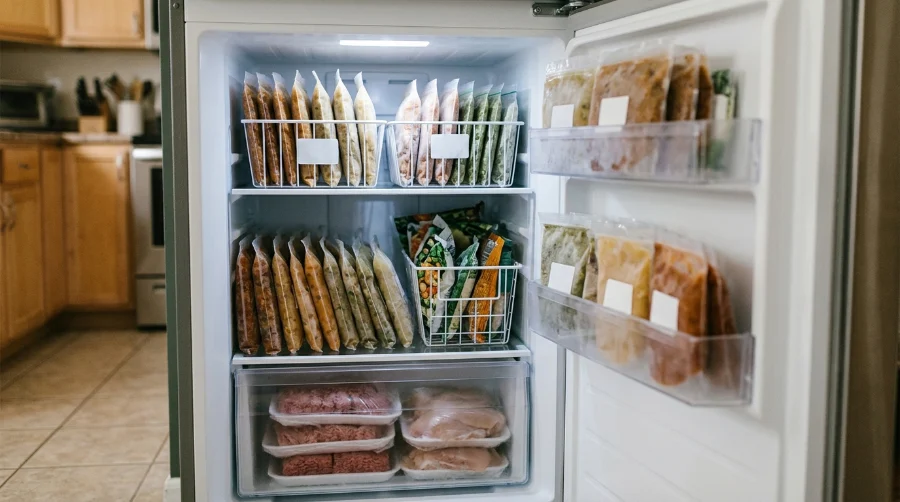
A freezer is easy to forget until something is lost at the back of it. Unlike a fridge, it hides food in solid blocks and frost, and a bag of vegetables can be…
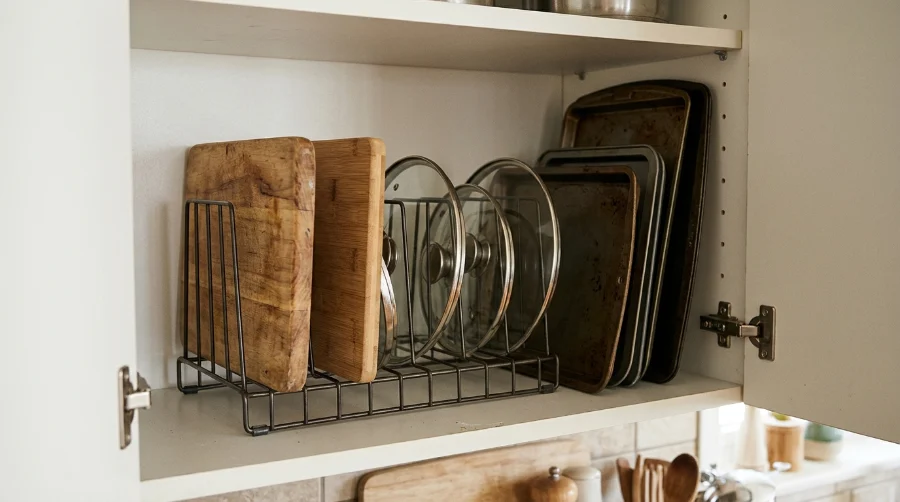
Some kitchen objects resist every ordinary storage method. Cutting boards, pot lids, baking trays and large flat utensils are awkward because they are wide, thin…