Kitchen Organization
Kitchen Cabinets - Why the Same Mess Returns
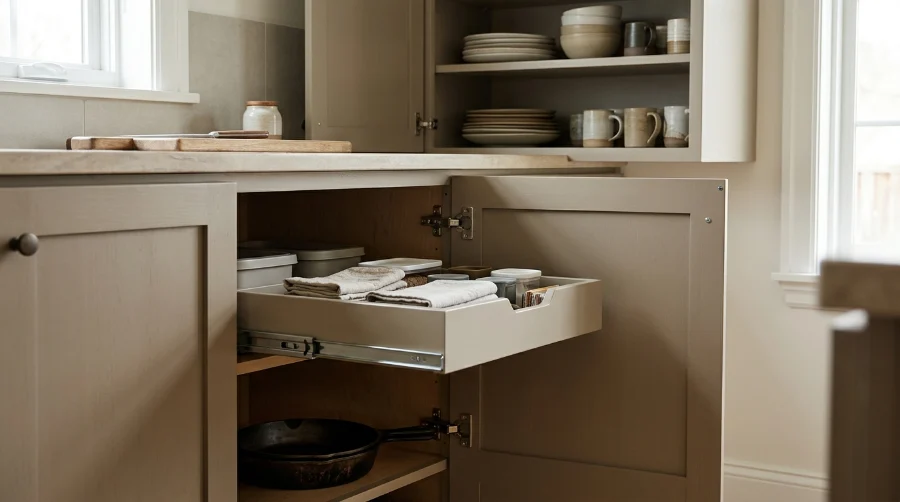
Most kitchen cabinets are not short of space; they are short of a plan. When a cupboard becomes hard to use, the usual response is to buy another organizer or tip…
Kitchen drawers are usually organized by object: all the spatulas together, all the wrapping together, all the cutlery together. That looks logical on a shelf plan…
Kitchen drawers are usually organized by object: all the spatulas together, all the wrapping together, all the cutlery together. That looks logical on a shelf plan, but it does not match the way a meal is made. Cooking moves in a sequence, and drawers work best when they follow that sequence.
Think through a normal evening meal. Ingredients come out, tools are used near the stove, food is plated, and wrapping or containers appear at the end. Each of those moments tends to happen in a different part of the kitchen. The drawers nearest each moment should hold what that moment needs.
This approach differs from sorting by category because it accepts that the same kind of item can belong in two places. There is nothing wrong with keeping one knife in the prep drawer and another near the stove if that is where each is actually used. A system built around real movement is easier to maintain than one built around tidy-looking groups.
Empty the drawers one at a time and place items into three rough piles: prepare, cook, and finish. Do not buy dividers yet. The first step is finding out what each pile contains and how much space it needs.
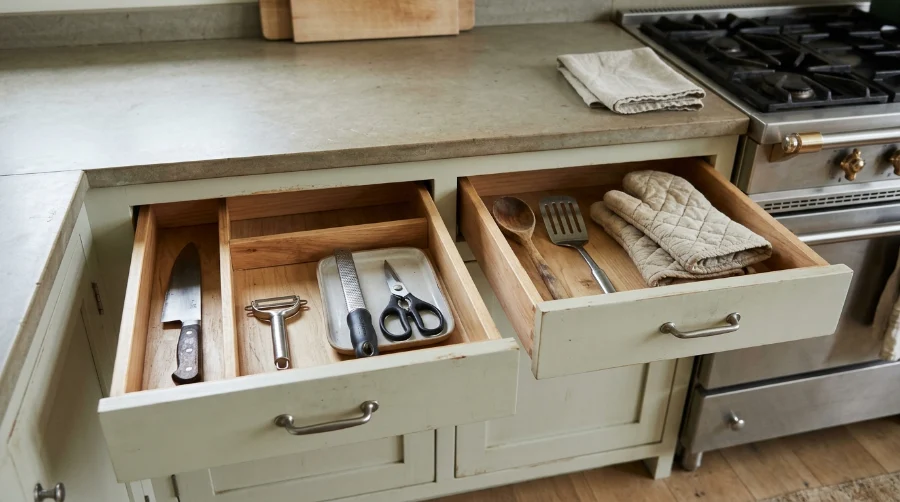
The drawer closest to the main work surface should hold the tools used before heat: a chef's knife, a small paring knife, a peeler, a cutting-board brush, and perhaps a pair of kitchen scissors. These items are reached for repeatedly in a short space of time, so they need to be visible the moment the drawer opens.
Keep this drawer shallow in what it holds. A deep drawer filled with prep tools becomes a layer cake, and the tool at the bottom is never used. If the prep drawer is deep, add a tray that lifts out, so the top layer can be moved aside without tipping everything onto the counter.
Measuring cups and spoons often live here as well, but only if baking is a regular activity. If they are used twice a year, store them elsewhere and give the everyday tools the space. The drawer should reflect the kitchen's habits, not its ambitions.
Beside the stove, keep the tools that tolerate heat and are used while food is cooking: a wooden spoon, a spatula, tongs, a ladle, and oven mitts. Metal utensils are fine here; plastic tools stored next to a hot burner can warp if the drawer is opened above the flame.
A common mistake is putting every cooking tool in this drawer until it can no longer close. Sort by what is used weekly and move the rest. A pasta server, a fish spatula, and a special whisk may all be useful, but if they sit under daily tools for months, they are not serving the kitchen.
Oven mitts deserve their own corner of the drawer or a hook beside it. A pair buried under utensils is a small safety problem, because anyone reaching into a hot oven wants to find protection immediately, not dig through a drawer.
The last stage of a meal needs a different set of things: serving spoons, place settings for everyday use, and the wraps or containers used for leftovers. Keeping these near the dining side of the kitchen stops people from crossing the work area with clean plates.
Food wrap, foil, and bags are awkward because their boxes are bulky and their rolls unwind. Store them standing upright in a shallow bin so one roll can be pulled out without the others falling over. If the drawer is too deep for upright storage, a vertical file organizer keeps the boxes sorted and visible.
Takeaway menus and takeout leaflets often end up in this drawer. Put them somewhere else. They are read once and then occupy space that clean plates need every day.
Shallow drawers suit flat tools, cutlery, and wraps. Deep drawers suit taller objects and stacks of containers, but they hide whatever sits at the back. A deep drawer used for everyday items almost always becomes a pile, so assign deep drawers to things that can be seen from above: pots, lids, or stacked bowls.
If a deep drawer must hold small tools, divide it into two levels with a sliding tray. The upper level holds daily items; the lower level holds occasional ones. This is more useful than a single large compartment because it does not require lifting everything out to reach the bottom.
Before installing any organizer, measure the inside of the drawer and the height of the tallest item it will hold. An insert that is too tall will prevent the drawer from closing, and one that is too loose will slide around every time the drawer moves.
Dividers are useful once the contents are stable. Adding them first forces every item to fit a layout chosen before the household's habits were known. Live with the sorted drawers for a week, then notice which items are constantly moved aside and which never move at all. Those observations should shape the dividers.
Adjustable dividers are worth considering in kitchens where the contents change with the seasons. A tray that can be lifted out is even more flexible, since it can be moved to another drawer if the cooking routine changes.
Do not keep duplicate tools in several drawers "just in case". Three can openers in three different places usually means none of them is where it is needed. One reliable tool with a known home is easier to find than three scattered ones.
Avoid storing heavy items above eye level in wall drawers, and do not stack sharp tools loosely where a hand can land on them. Child locks are worth fitting in any drawer that holds knives, scissors, or strong cleaners, especially in a kitchen used by visitors as well as the household.
Finally, do not treat the drawer as a place for things that have no other home. Screwdrivers, spare buttons, and shopping receipts all arrive there because the kitchen is central. Each one displaces something used daily. A small bowl elsewhere for odd items prevents this drift.
Once a week, open each drawer and put back anything that belongs in another zone. This takes only a few minutes and stops the slow mixing that defeats the system. If a tool repeatedly turns up in the wrong drawer, ask why. It may be used in two places, or its correct zone may have been chosen poorly.
Organized kitchen drawers are not about symmetry or matching containers. They are about reaching the right tool at the right moment without stopping to search. When the drawers follow the way a meal is actually prepared, the kitchen becomes calmer and faster to use.
Guides that pair well with this one.
Most kitchen cabinets are not short of space; they are short of a plan. When a cupboard becomes hard to use, the usual response is to buy another organizer or tip…
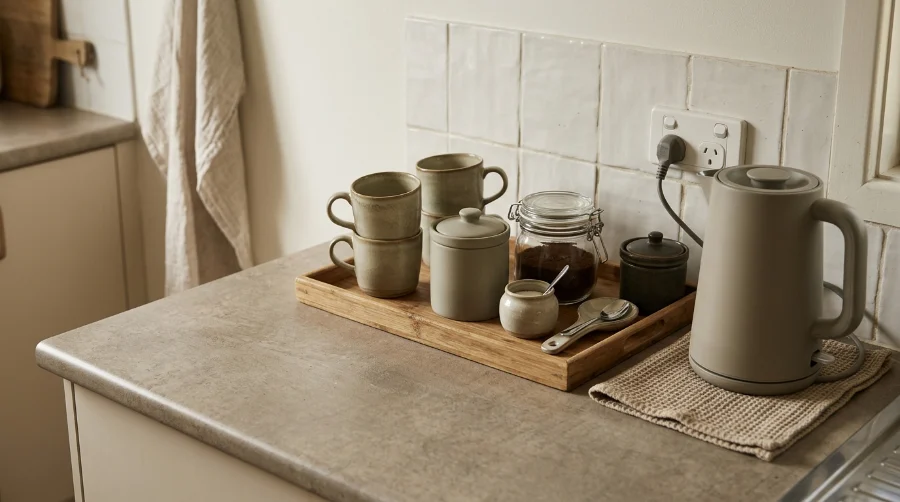
Making a hot drink is a small sequence repeated many times a day: reach for a cup, add coffee or tea, boil water, sweeten, stir, and clean up. When those six steps…
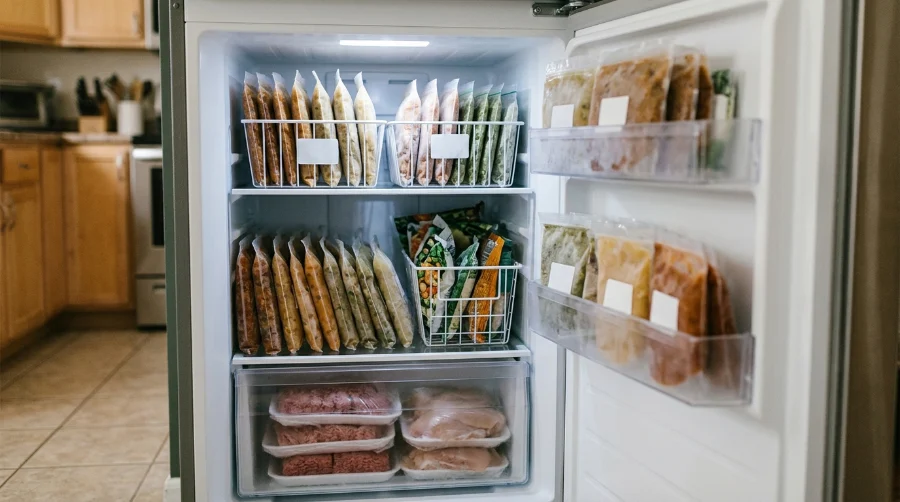
A freezer is easy to forget until something is lost at the back of it. Unlike a fridge, it hides food in solid blocks and frost, and a bag of vegetables can be…