Kitchen Organization
A Clear Counter With a Home for Everything
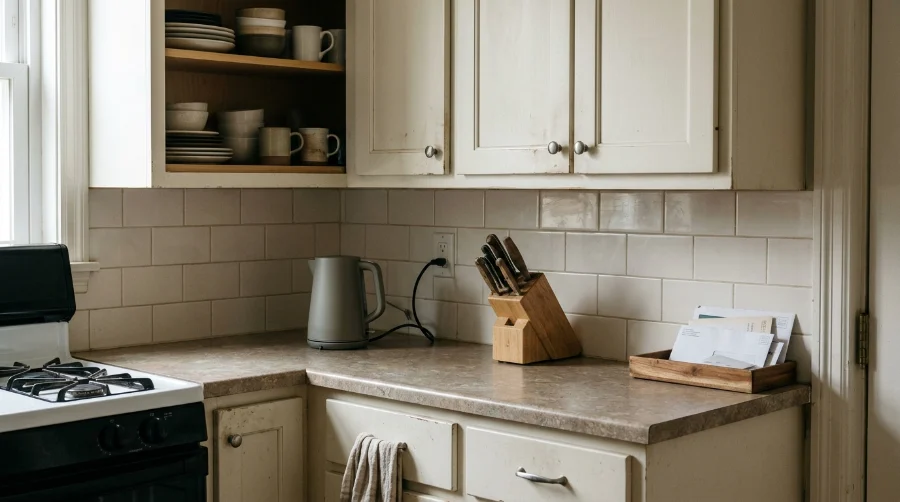
Counter clutter is rarely caused by owning too many things. It appears when items have no reliable home, so the counter becomes the default. Clearing it…
Some kitchen objects resist every ordinary storage method. Cutting boards, pot lids, baking trays and large flat utensils are awkward because they are wide, thin…
Some kitchen objects resist every ordinary storage method. Cutting boards, pot lids, baking trays and large flat utensils are awkward because they are wide, thin and easy to stack in a way that makes the bottom item impossible to reach. Storing them well is mostly a question of turning them upright, keeping similar items together and putting them where the person cooking can grab one without moving three others.
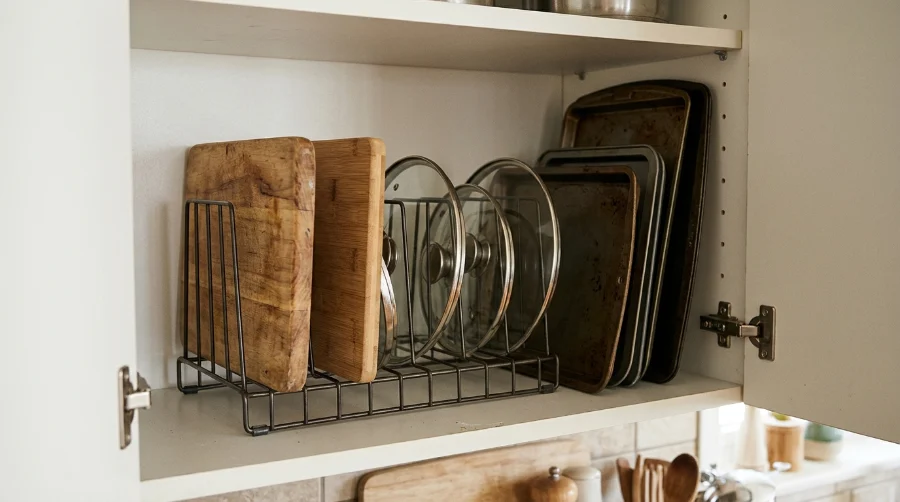
Flat, rigid objects store best on their edge. Laid flat, a stack of lids or trays becomes a pile where only the top one is accessible, and the pile tends to topple when someone reaches underneath. Standing the same items upright separates them and lets a person see and take any one of them. Once that principle is clear, the possible locations become much easier to evaluate.
Measure the height and width of the items before choosing a container. A chopping board may be taller than a standard drawer allows, while a set of baking trays may need a full-height cupboard slot. Knowing the dimensions prevents buying an organizer that fits the shelf but not the objects.
A simple metal file rack, the kind used for paperwork, is one of the most useful tools for this problem. Stand pot lids and cutting boards in the slots, separated by size. Each item is visible at a glance and can be pulled out singly. The rack can sit inside a cupboard, on a shelf or, where space allows, on the counter beside the stove.
Choose a rack with wide enough slots and a stable base, since a loaded rack of heavy lids can be top-heavy. Group lids near the pots they belong to if possible, or keep all lids together in one predictable spot. A small label on the shelf helps other household members return items to the right place.
Many kitchens have a narrow gap beside the fridge, the oven or a worktop that is too slim for a shelf but ideal for upright storage. A slim trolley or a vertical rack can slide into this space and hold boards, trays and lids on their edge. Before using a gap, check that the appliance door can still open and that there is room for ventilation where required.
Keep the heaviest items at the bottom of any narrow rack so it stays stable. If the gap runs behind a door, use a rack with wheels so it can be pulled out when needed and pushed back afterwards.
The inner face of a cupboard door is often completely unused. A door-mounted rack can hold a row of lids or a few lightweight trays, freeing a whole shelf. This works particularly well in a corner cupboard where the deep shelf is hard to reach.
Check the door hinge direction and the clearance inside the cabinet before fitting anything. A rack that sticks out too far will stop the door closing or collide with the shelves. Use fixings suited to the door material and avoid overloading the hinges with heavy cast-iron lids.
A wide, shallow drawer can store flat items upright if fitted with dividers. Trays and boards slot in side by side, and the whole collection is visible when the drawer is opened. This is a cleaner solution than a cupboard shelf because nothing is hidden behind anything else.
Full-width drawers are best for long baking trays. If the drawer is shallow, store only thin cutting mats and lids there and keep full-sized boards in a cupboard. Add non-slip liner so items do not slide around each time the drawer moves.
Where more than one cutting board is kept, it is worth separating boards used for raw meat from those used for bread or vegetables. Store them apart, ideally with one clearly marked, so they are not swapped by mistake. This matters more than the exact storage location and takes only a moment to organize.
Boards should be stored standing so air can circulate and both sides dry fully after washing. Putting a damp board flat against another traps moisture and encourages smells. A rack that keeps them apart solves the hygiene problem as well as the space problem.
Baking trays are notoriously awkward because they vary in size and slide around when stacked. File them upright in a deep cupboard or a dedicated rack, grouped by size. If nesting is unavoidable, place a sheet of parchment or a thin cloth between trays so they separate easily and do not scratch.
Keep roasting tins near the oven and store their racks either nested inside or hung from a wall hook. A tin that is used every week should not be at the back of a high cupboard. Match the storage effort to how often the item is used.
Stacking everything flat may save a few centimetres of shelf, but it means untangling a pile every time the oven is used. Upright storage usually takes no more room and saves a great deal of frustration. Lids kept far from their pots create a similar problem, turning a simple task into a trip between two cupboards. Keeping a lid beside its pan removes that small daily annoyance.
Avoid buying an organizer that needs assembly in a tight cupboard if it cannot be taken out to fill. Check that the solution can be lifted in and out for cleaning, and that crumbs and grease can be wiped from the area underneath.
Cutting boards, lids and trays become manageable once they stop lying in piles. Stand them upright in a file rack, a divider or a narrow gap, keep similar items together and put them close to where they are used. None of these solutions is expensive or complicated, but together they turn the most frustrating corner of the kitchen into one of its most orderly.
Guides that pair well with this one.
Counter clutter is rarely caused by owning too many things. It appears when items have no reliable home, so the counter becomes the default. Clearing it…
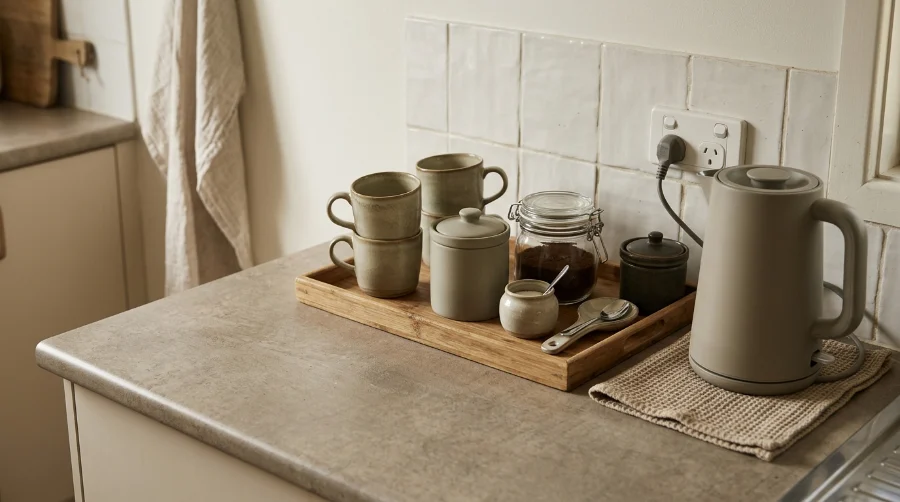
Making a hot drink is a small sequence repeated many times a day: reach for a cup, add coffee or tea, boil water, sweeten, stir, and clean up. When those six steps…
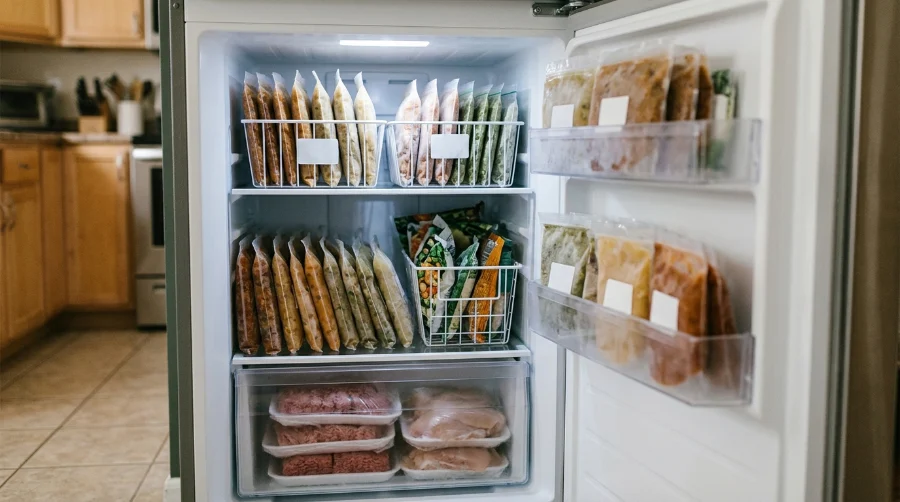
A freezer is easy to forget until something is lost at the back of it. Unlike a fridge, it hides food in solid blocks and frost, and a bag of vegetables can be…