Home Organization
A Donation Station That Doesn't Sit in a Closet
A donation bag left in a closet usually stays there. The idea was sound, but the bag was out of sight and nobody had to pass it. A donation station works better…
A garage is usually the biggest storage space in a home and the one that causes the most frustration. It has no rooms to define what belongs where, it doubles as a…
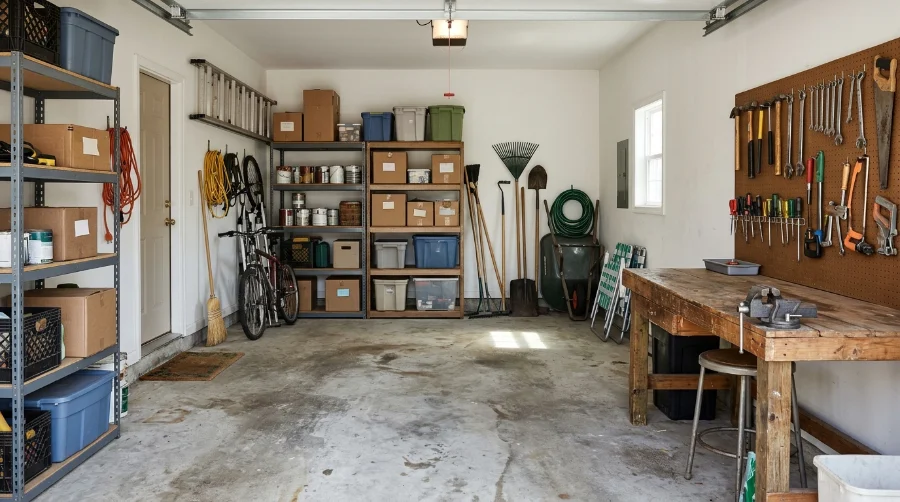
A garage is usually the biggest storage space in a home and the one that causes the most frustration. It has no rooms to define what belongs where, it doubles as a route to the house, and it absorbs everything that has nowhere else to go. Organizing one rarely fails because of a lack of effort. It fails because a few predictable mistakes turn a hard-working space into a place nobody wants to enter.
The most common first move is to drag everything out onto the drive, admire the empty garage, and then face a huge pile with no system for putting it back. Clearing is necessary, but it should follow a rough plan rather than replace one. Before moving boxes, decide which broad zones the garage needs: tools, garden equipment, sports gear, car care, seasonal decorations, and a clear path to the house door.
Without those zones, everything goes back to the nearest wall and the same clutter returns within a month. Sketch a simple layout on paper, marking the door swing, the path a person walks to the house, and any fixed fixtures such as a boiler or a workbench. The plan does not need to be perfect; it needs to exist before the sorting begins.
Many garages are the main entrance to the home. If the path from the car to the internal door is blocked, the space becomes irritating every single day, and things start being dropped in whatever gap is left. Protect a clear corridor first, before adding any storage. A walkway of roughly three feet is comfortable for carrying shopping or a child, though a smaller space may have to make do with less.
Store tall and bulky items against the walls, never where they project into the walking line. If the garage is truly narrow, wall-mounted and hanging storage keep the floor free in a way that freestanding shelves cannot. Test the route with the door open and with a loaded armful before committing to a layout.
A new set of shelves feels like the answer, but shelves only help if they suit the items and the wall. Overloading a cheap shelf with heavy paint tins or toolboxes is both a mess and a hazard. Check the stated load of any shelving and anchor tall units to the wall so they cannot tip.
Shallow shelves suit small boxes and tins. Deep shelves suit bulky items, but deep shelves hide whatever is at the back. Where depth is unavoidable, use bins that slide out or stack two rows so the rear items can still be reached. A shelf that requires unpacking three boxes to reach a screwdriver does not save time.
Floor space in a garage is precious, yet many people try to solve storage problems entirely on the ground. Walls and ceiling space are usually unused. Pegboards hold hand tools where they can be seen and returned. Wall rails with hooks take long-handled tools, ladders and garden equipment. Overhead racks can hold lightweight seasonal boxes, provided they are fixed to joists and nothing is stored above a door that opens outward.
Ceiling storage has limits. Heavy or frequently used items do not belong overhead, and anything stored there must be securely contained so it cannot fall. Use it for light, rarely needed things such as empty boxes or camping gear in sealed containers.
Seasonal items are the main reason garages overflow. When holiday decorations, winter equipment and summer gear sit beside the tools used every week, the everyday things become hard to reach. Group seasonal items together in clearly marked containers and store them as a single block toward the back or overhead. The aim is not to hide them forever, but to make them predictable.
Be realistic about volume. If a family owns more seasonal equipment than the garage can hold, the excess needs to be reduced, donated, or stored elsewhere. No layout can create space that the objects themselves occupy.
Garages often hold unfinished painting jobs, a dismantled appliance, or a pile of materials kept for a project that may never happen. These are not storage problems; they are decisions left unmade. Give each unfinished item a deadline. If there is no realistic plan to finish it, pass it on or dispose of it responsibly.
Keep one small, defined area for active projects and treat it as temporary. A project that spreads across half the garage will quietly consume the space and block everything else.
A garage is a working space and often a workshop, so safety cannot be an afterthought. Store sharp tools out of reach of children and keep them in a locked cabinet where necessary. Flammable liquids belong in an approved container, away from heat sources and pilot lights, in a well-ventilated spot. Never leave chemicals in open jars or unlabelled bottles.
Check that stored items do not obstruct the door mechanism, the boiler, or any electrical panel. Keep a clear route to the internal door in case of an emergency, and make sure a light can be switched on before entering. Good organization should make the garage safer, not simply tidier.
One subtle error is buying containers before sorting. Storage bins are satisfying to purchase, but they encourage keeping things simply to fill them. Sort and reduce first, then buy only the containers the remaining items actually need.
Another is organizing the garage once and expecting it to stay that way. A garage is a working space, so a short tidy every few weeks is realistic. Return tools after use, put seasonal items back in their block, and deal with packaging before it accumulates. A little repeated care is easier than another full clear-out.
A well-organized garage does not look like a showroom. It has a clear route to the house, a home for the tools and equipment used regularly, and a predictable place for things that only come out once a year. The mistakes above are all about skipping decisions: what belongs, what goes, and where things return. Make those decisions once, and the space becomes far easier to keep working.
Guides that pair well with this one.
A donation bag left in a closet usually stays there. The idea was sound, but the bag was out of sight and nobody had to pass it. A donation station works better…
A screwdriver in the kitchen drawer, a tape measure in the car, a pair of pliers on a shelf in the garage: a home tool kit rarely starts out scattered, but it often…
Almost every home has one drawer that defeats every good intention. It holds batteries beside takeout menus, a lonely screw next to three unmatched rubber bands…