Home Organization
An Entryway Drop Zone That Holds Its Shape
A drop zone is not really a piece of furniture. It is a defined place where the things you carry every day land before they spread through the rest of the house. In…
Almost every home has one drawer that defeats every good intention. It holds batteries beside takeout menus, a lonely screw next to three unmatched rubber bands…
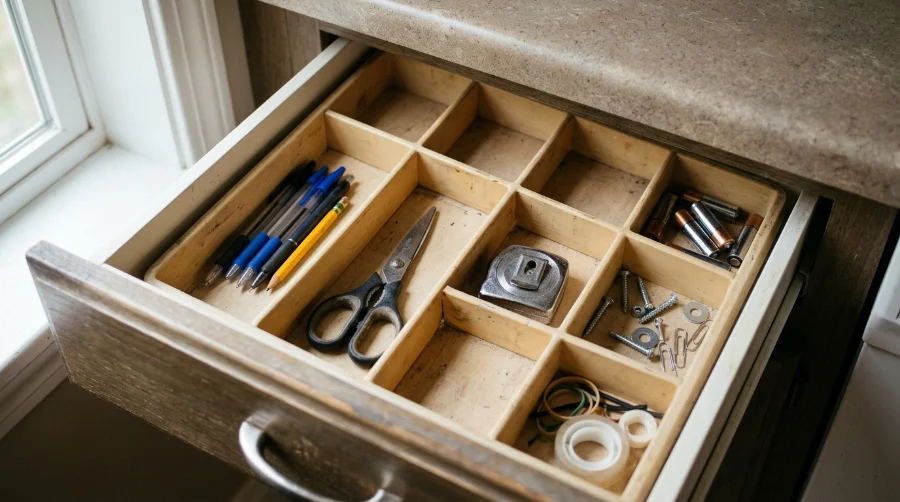
Almost every home has one drawer that defeats every good intention. It holds batteries beside takeout menus, a lonely screw next to three unmatched rubber bands, and a pen that stopped working two years ago. The junk drawer is not a design failure. It is the natural result of a household needing somewhere to put small things that have no obvious home. The goal is not to abolish it, but to make it a drawer that still opens without a small avalanche falling out.
A junk drawer fills up because it is convenient and because its contents have no better destination. The first step is not sorting, but noticing what actually lands there over a normal week. Most drawers collect a handful of recurring categories: writing tools, loose change, cables and adapters, batteries, small hardware from furniture assembly, takeout menus and loyalty cards, and a few odd items that belong somewhere else entirely.
Recognizing the pattern matters because it tells you what the drawer is really for. In many homes it functions as a landing spot for things used once and then set down in a hurry. If that is the case, the drawer needs to be easy to put something into and easy to find things in again. A system that demands perfect discipline will fail within a fortnight.
Pull the entire contents out and lay them on a table or a clean worktop. Working with an empty drawer is far easier than sorting one item at a time in place. Sort as you go into three rough piles: things that belong in this drawer, things that belong elsewhere in the home, and things that are finished.
The finished pile is usually the largest and the most liberating. Dead pens, dried-out markers, expired coupons, cables for devices nobody owns, and half-used packets of screws from furniture long since assembled can all go. Broken items that are worth repairing can move to a single designated spot, but avoid creating a second junk drawer in the name of order.
The main reason a junk drawer slides back into chaos is that it is expected to hold anything. Give it a narrow set of jobs instead. A sensible list for most households is small tools and hardware, writing tools, batteries, and a few everyday extras such as a tape measure or a pair of scissors. Anything outside that list gets a different home.
Be honest about what the household actually uses. A family that never writes a cheque has no reason to keep a chequebook in the drawer. A household that burns through batteries for children's toys may need a generous battery section and a note of the sizes that get replaced most often. Building the drawer around real habits is what keeps it useful.
Loose items roll together and bury one another. Dividers give each category a boundary so a handful of screws cannot migrate across a pen. There are several options, and the right one depends on the drawer depth and the items it holds.
Measure the drawer before buying an organizer. An insert that has to be squeezed in will be the first thing removed when it jams. Leave a little clearance on each side so the drawer slides smoothly, and check that the dividers do not stop the drawer closing fully.
Most junk drawers are shallow, which encourages everything to lie flat in one layer. Where the drawer has a little depth, stacking small containers can double the usable space. Keep the items used most often on top and reserve the lower layer for spares. A shallow second tier or a set of stacking tins works better than piling loose objects, which simply recreates the original problem in two dimensions.
If the drawer is genuinely too small, the answer is usually to reduce what goes into it rather than to find a cleverer container. A crowded drawer that nobody can search is worse than a smaller, honest collection that gets used.
A tidy drawer that hides everything in opaque boxes is only half organized. Label the sections briefly if there is more than one person in the household, so nobody has to open every tin to find a battery. A label does not need to be elaborate; a word written on a piece of masking tape is enough and can be changed when the contents change.
Keep like items together and put the most-used group at the front or top. Very small items such as spare keys or earbuds are easy to lose in a large compartment, so give them a small container of their own. The aim is that a person can reach the right thing without tipping everything else out.
A junk drawer will always collect a few stray items. That is its nature. A short reset once a week prevents those strays from turning into a full-blown mess. Set a reminder and spend two minutes taking out anything that clearly belongs elsewhere, returning stray tools to their home, and removing any packaging that has crept in.
The reset should be short enough that nobody dreads it. If it regularly takes more than a few minutes, the drawer is holding too much or its categories are too broad. Adjust the system rather than trying harder to follow it.
One frequent mistake is buying an organizer before deciding what belongs in the drawer. The container then dictates the contents, and the household ends up storing things it never uses simply to fill the compartments. Sort first, measure second, and buy last.
Another is treating the drawer as a permanent home for items that are only there temporarily. A birthday card to be posted, a form to be signed, or a parcel to be returned all need an out tray or a visible reminder somewhere else. When important items disappear into the junk drawer, the drawer stops being helpful and starts costing time.
A well-run junk drawer is modest. It holds a small set of useful things, keeps them visible, and gets a brief tidy each week. It does not need to look like a photograph in a storage catalogue. What matters is that the household knows what is in it and can put a hand on the right item without digging. When the drawer serves that purpose, it earns its place.
Guides that pair well with this one.
A drop zone is not really a piece of furniture. It is a defined place where the things you carry every day land before they spread through the rest of the house. In…
A donation bag left in a closet usually stays there. The idea was sound, but the bag was out of sight and nobody had to pass it. A donation station works better…
In a busy household, information tends to scatter. One person keeps the school letter in a bag, another writes appointments on a phone, and a third leaves a note on…