Home Organization
Why Garages Stay Cluttered and How to Fix It
A garage is usually the biggest storage space in a home and the one that causes the most frustration. It has no rooms to define what belongs where, it doubles as a…
A screwdriver in the kitchen drawer, a tape measure in the car, a pair of pliers on a shelf in the garage: a home tool kit rarely starts out scattered, but it often…
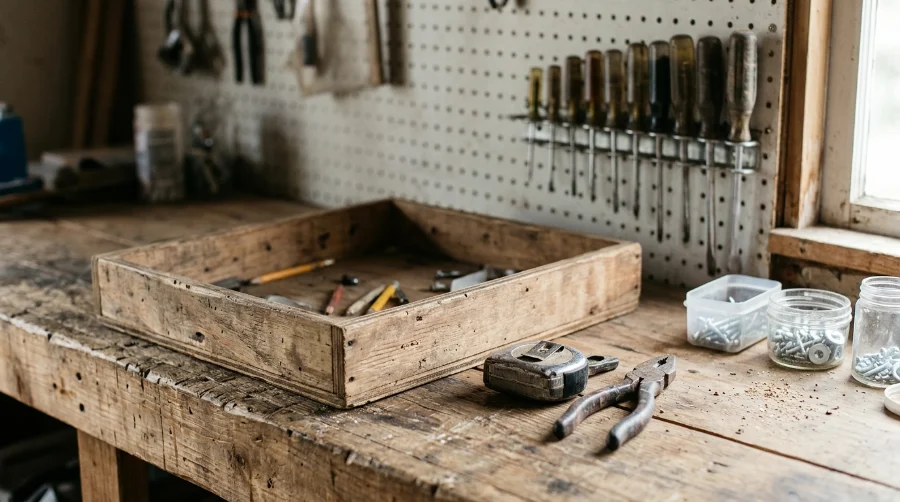
A screwdriver in the kitchen drawer, a tape measure in the car, a pair of pliers on a shelf in the garage: a home tool kit rarely starts out scattered, but it often ends up that way. Tools migrate because they are used in different rooms and set down wherever a job happened to finish. The collection may own everything needed for a small repair while making it almost impossible to find any single item. Organizing that collection is a different job from assembling a first repair kit from nothing. The tools already exist; the work is giving them a predictable home.
A drawer arranged by appearance looks tidy for about a week. Long tools lie together, short tools lie together, and everything sits in a neat parallel line. Then a shelf, curtain rod, or loose floorboard needs attention, and the hand reaches for a screwdriver, a measuring tape, and a clamp in quick succession. Grouping by shape scatters that sequence across three places. Grouping by task keeps it in one region, which is how real work actually happens.
Five broad groups cover most household tools. The names matter less than the principle behind them: each group should answer the question of what the hand is trying to do.
This group holds screwdrivers, driver bits, bit holders, ratchets, socket sets, and hex keys. Keep tips visible rather than buried. A rack that shows the flat, cross, and star ends at a glance removes the guessing that slows down a job. Order the pieces from smallest to largest within the group, and keep rarely used sizes in the same place rather than a separate drawer. A missing screwdriver is usually a screwdriver that migrated into a general junk pile, so give this group a boundary that is easy to see.
Tape measures, a metal ruler, a small square, a level, and a marking pencil belong together. These tools are often used in pairs: measure, then mark; mark, then check for level. Storing them flat prevents the tape casing from rolling and the pencil from disappearing under a stack of bits. If a long level takes too much room, it can live elsewhere, but the short measuring tools should stay within reach of the fastening group.
Utility knives, scissors, snips, a small hacksaw, and spare blades form the cutting group. Sharp edges need a sheath or a dedicated slot, and loose blades should never share a compartment with screwdriver tips. This group also benefits from being kept slightly apart from where hands reach most often, especially in a household with children. A cutting tool that is visible and predictable is safer than one tucked into a crowded drawer where it is found by accident.
Pliers, an adjustable wrench, and a few clamps make up this group. They are the tools used when something needs to be held, turned, or pulled. Clamps are awkward because they come in several sizes and tend to roll. Standing them on end in a deep bin or hanging them by the handle keeps them from sliding under other tools. The goal is to grab the right size without lifting out everything else.
Sandpaper, a scraper, a putty knife, and a stiff brush finish most small jobs. These items are often dirty when put away, which is why they end up outside the kit. Give them a tolerant container that can be wiped out, and keep a few sheets of abrasive material in a flat sleeve rather than loose. Finishing tools work best as the last group in the sequence, close to wherever the kit is put away.
Three storage styles dominate: a tray, a portable toolbox, and a wall-mounted arrangement. Each suits a different pattern of use, and the right choice depends on where the work tends to happen.
A shallow tray suits a single drawer or shelf. It lifts out as a unit, which makes it easy to carry to the task and easy to put back. The limitation is depth: a tray encourages a single layer, so it works best for a modest collection. A deeper tray can hold two layers only if the upper one lifts away cleanly.
A toolbox suits tools that are regularly carried between rooms or to a car. Its strength is portability, but a deep box without internal divisions becomes a pit. Compartments, removable trays, or a small insert turn the same box into a readable system. Choose a box that can be carried comfortably when full; a container that is too heavy to move will be left in one place and slowly emptied of its contents.
Wall-mounted storage suits a workshop, garage, or utility space where the tool kit has a permanent station. A pegboard or slotted panel keeps shapes visible and returns everything to the same spot. The trade-off is that nothing travels. If most repairs happen at the kitchen table, a wall display in the garage solves an organizational problem while creating a practical one. A hybrid works well in many homes: everyday groups in a portable tray, and long or specialized pieces on the wall.
Once groups are set, arrangement inside each one matters more than the container itself. Order tools by size, with the smallest at the front or top. Keep handles in the same direction so the hand does not have to reorient each tool. Avoid stacking different types directly on top of one another; a stack hides the bottom item and discourages its use.
Visibility beats compression. A crowded container that holds everything looks efficient but functions poorly, because finding one tool requires disturbing several others. If a group has outgrown its space, split it rather than pressing it in. Two small trays side by side are easier to manage than one overfilled box. Spare capacity is not wasted space; it is the room that makes the system survive a busy afternoon.
Label the outside of trays or compartments with the task name rather than a list of contents. A single word such as fastening or measuring is quicker to scan than a detailed inventory, and labels stay accurate when a new tool joins the group. Names also help other household members return items to the right place.
Screws, wall plugs, nails, washers, tape, and spare blades are consumed rather than used indefinitely. Mixing them loose into the bottom of a toolbox is the fastest way to lose both the consumables and the tools buried beneath them. Keep them in small clear containers or a divided tray, sorted by type and rough size.
Transparency matters here because these items are small and easily confused. A closed opaque box requires opening several lids to find one washer. Shallow clear containers let the contents be identified at a glance and stack without hiding what is inside. A simple sort by type, then by size, is enough for most households; finer categorization adds work without adding speed.
Partly used packs deserve a defined spot. A half-empty packet of fixings pushed to the back of a shelf will be forgotten and eventually duplicated. Keep opened packs together in one shallow bin, and place new purchases behind the ones already open. This is a small habit that prevents the slow accumulation of duplicate small parts.
An organized tool kit does not stay organized by itself. The difference between a system that lasts and one that collapses is a short reset that happens often enough to feel trivial. After a job, return tools to their groups before doing anything else. The whole sequence takes less time than searching for a missing item during the next job.
A slightly longer review once or twice a year handles the rest. Open each group, remove anything that does not belong, and check that cutting edges are covered and marking tools still work. Replace or sharpen worn items, and move tools that have never been used into a separate storage area rather than leaving them to crowd the everyday set. This review is not a full reorganization; it is a check that the original logic still matches the household's habits.
Some households keep a small notebook or a simple list with the kit, noting items that have run low or failed. This works well for consumables and for less common sizes that are easy to overlook. The list should stay brief. A system that demands careful record-keeping will be abandoned, while one that needs a quick glance will survive.
A portable kit has limits. Jobs that involve holding a piece steady while cutting, drilling, or sanding need a stable surface, and balancing a board on a kitchen table is both slow and awkward. A workbench becomes worthwhile when these situations happen regularly rather than occasionally.
The decision comes down to floor space and frequency. A small folding bench or a sturdy shelf at elbow height can serve a household that does occasional assembly and simple repairs. A full bench with a vise makes sense where projects happen most weekends and where materials need to be clamped, measured, and worked on repeatedly. In a crowded home, a wall-mounted fold-down surface offers a compromise: a real work area that disappears when not in use.
It is also reasonable to stop at a well-organized kit. Many households can manage years of small repairs with a tray, a divided box, and a clear shelf. Adding furniture before the need is clear often creates a new surface for tools to scatter across. Let the frequency of real jobs decide whether the collection needs a permanent station or simply a more disciplined home.
Guides that pair well with this one.
A garage is usually the biggest storage space in a home and the one that causes the most frustration. It has no rooms to define what belongs where, it doubles as a…
Almost every home has one drawer that defeats every good intention. It holds batteries beside takeout menus, a lonely screw next to three unmatched rubber bands…
A drop zone is not really a piece of furniture. It is a defined place where the things you carry every day land before they spread through the rest of the house. In…