Home Organization
A Junk Drawer That Doesn't Refill Itself
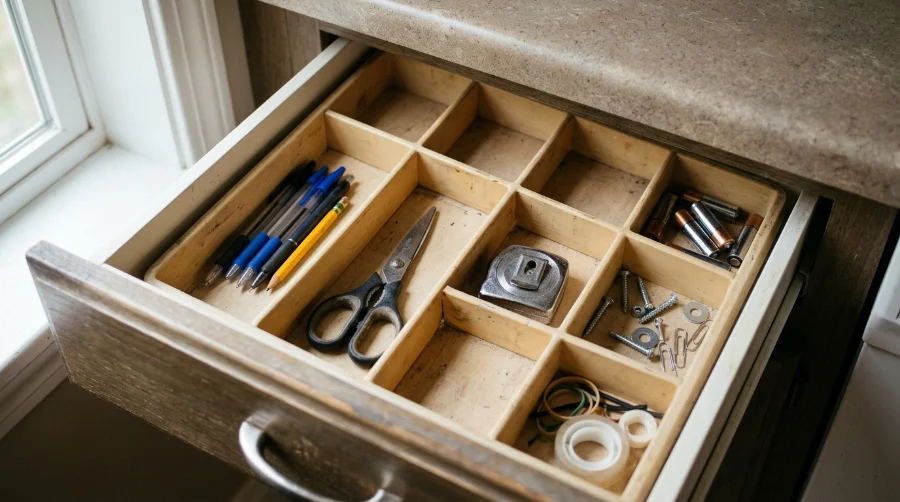
Almost every home has one drawer that defeats every good intention. It holds batteries beside takeout menus, a lonely screw next to three unmatched rubber bands…
Craft and sewing supplies are difficult to put away because so much of them is small. Buttons, beads, threads, snaps, and scraps are easy to drop into a single…
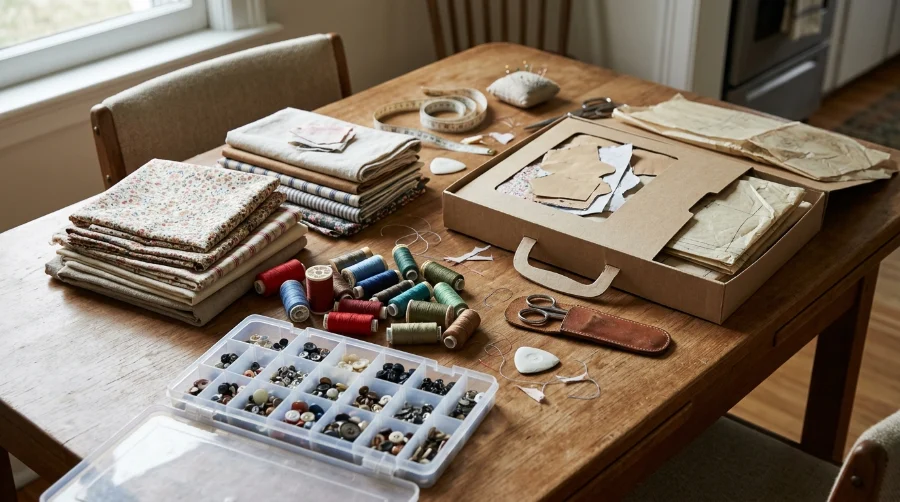
Craft and sewing supplies are difficult to put away because so much of them is small. Buttons, beads, threads, snaps, and scraps are easy to drop into a single container and almost impossible to sort out again. A project left on the table spreads across it, and in a small room there is nowhere for that spread to go. The answer is not a larger room or a bigger box. It is containment that keeps each type visible and each project separate from the next.
Loose supplies should never share one large bin. A deep container holding everything becomes a layer of mixed pieces, and the only way to find a particular button is to tip the contents out. Start with shallow containers instead, divided into sections by type. Small clear boxes with lids work well because they can be stacked and read from above without opening them.
Sort by kind before sorting by color or size. A box for buttons, one for fasteners, one for threads, and one for small findings is easy to understand and easy to put back. Within each box, a simple order from small to large is enough. Elaborate systems with many tiny categories look efficient but take longer to maintain than the average hobby session allows.
Visibility is the feature that matters most. Clear containers or open tray compartments let the contents be seen at a glance, which stops duplicate purchases and reduces the time spent searching. Label the outside of each container with a short word rather than a full inventory. Labels also help when more than one person uses the supplies, since everyone can see where things belong.
Very thin items such as pattern pieces, templates, and flat trims benefit from a different approach. Store them upright in file dividers or slim envelopes, sorted by project or by type. Upright storage lets one sheet be pulled out without disturbing the rest, which is not possible with a stack.
Most craft clutter comes from mixing two different things: supplies waiting to be used and supplies already committed to a project. A half-finished garment, its pattern, and the matching thread look like random materials once they are set down beside the general stash. Keeping them together is the single most useful change a small space can make.
Give each active project its own box or bag. The container should hold the fabric or paper already cut, the pattern or instructions, the tools specific to that project, and any remaining trims. When the project resumes, everything needed is in one place, and the table can be cleared in a single movement. When the project ends, return unused materials to the general containers and free the box for the next one.
Limit the number of active projects to what can realistically be stored. Two or three boxes are manageable on a shelf or under a bed; eight boxes become a second stash. Choosing which project is truly active is occasionally uncomfortable, but it keeps the distinction meaningful. A project that has not been touched for a long season can be packed away as a future idea rather than left occupying prime space.
In many homes, crafting happens at the dining table, on the floor, or in different rooms depending on the day. A container that can be carried makes this practical. Look for a box with a sturdy handle, a secure lid, and a shape that fits the space where it will be stored. A shallow, wide box slides under a bed or onto a shelf more easily than a tall one.
Check that the interior accepts the items already cut. A ruler, a cutting mat, or a large pattern piece may set the minimum size, and a box that is too small forces those items back onto the table. On the other hand, a box that is too large encourages the whole project to expand into it. Aim for a snug fit with a little room for the odd extra piece.
Stackability matters when several projects are stored together. Boxes of the same shape stack neatly and make the shelf readable, while mismatched containers waste the gaps between them. A clear lid is useful for identifying the project without opening every box. A simple external label with the project name or a short description works just as well.
Fabric and paper crease when they are forced into spaces that do not suit them. Fold pieces along existing creases where possible, then store them flat in shallow drawers, on closet shelves, or in covered boxes. Keep similar sizes together so that a large sheet is not buried under a pile of small scraps.
Rolling works well for many woven fabrics and for large paper sheets that crack if folded repeatedly. A roll can stand upright in a tall bin or lie horizontally on a shelf, and individual pieces can be removed without unfolding everything. For smaller scraps, a vertical filing system in a box lets each piece be seen by its edge. This is especially useful when scraps are sorted by color, since a specific shade can be pulled without leafing through a stack.
Keep light-colored and white materials in a covered container if they are exposed to daylight, since prolonged sun can discolor them over time. Place heavier rolls and boxes at the bottom of a stack and lighter ones above. A shelf that holds fabric should not be overloaded to the point where pieces are compressed; compressed fabric is hard to remove and easy to crease.
Needles, pins, craft knives, and rotary blades need a home of their own, separate from soft supplies. A pin cushion or a small lidded container keeps needles from being lost in fabric, and a counted set makes it obvious when one is missing. Blades should be covered or retracted before they are put away, and never left loose where a hand might reach into a bag.
Storage height matters in a household with children. Sharp tools belong in a drawer or cupboard that can be closed, ideally above the reach of small hands, and project boxes should not be left open on low furniture. A lockable box is worth considering where very young children are present. The habit of closing a container after each session does more for safety than any single storage product.
Sharp tools also benefit from a consistent spot. A knife returned to the same sheath each time is less likely to be left on a chair or under a pile of cloth. Keep a small container for offcuts of blade material and broken needles so they can be disposed of safely rather than dropped into a general bin.
Scraps accumulate because every offcut feels potentially useful. Some are, but a collection grows past the point of being usable long before it fills a room. A periodic review keeps the stash honest. Choose a moment when a container is full and deal with it before buying another container. This single rule prevents most small-space storage problems from getting worse.
Sort scraps by usable size. Pieces large enough for a small project stay; tiny offcuts that cannot be gripped or sewn are better released. Materials that no longer fit the household's interests can be passed on, traded, or donated. Keeping a small amount of variety is useful, but keeping every remnant limits the space available for the projects that matter now.
The review should also check the containers themselves. Empty boxes, worn dividers, and lids that no longer fit take up space without holding anything useful. Replace only what is needed, and keep the number of containers fixed where possible. A small space has a natural limit, and working within it is easier than repeatedly reorganizing an ever-growing collection.
Guides that pair well with this one.
Almost every home has one drawer that defeats every good intention. It holds batteries beside takeout menus, a lonely screw next to three unmatched rubber bands…
A drop zone is not really a piece of furniture. It is a defined place where the things you carry every day land before they spread through the rest of the house. In…
A donation bag left in a closet usually stays there. The idea was sound, but the bag was out of sight and nobody had to pass it. A donation station works better…