Home Organization
A Junk Drawer That Doesn't Refill Itself
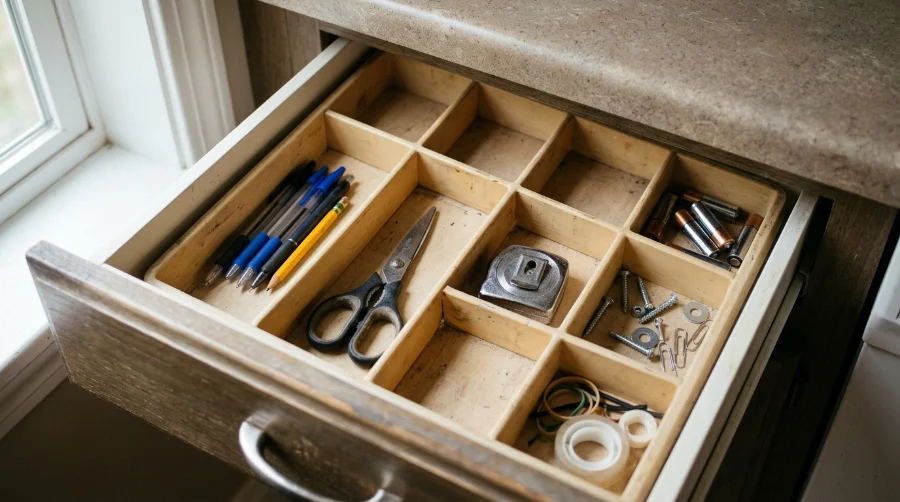
Almost every home has one drawer that defeats every good intention. It holds batteries beside takeout menus, a lonely screw next to three unmatched rubber bands…
Books have a way of arriving faster than shelf space appears. A few bought on a weekend become a stack on the bedside table, the stack spreads to the floor, and the…
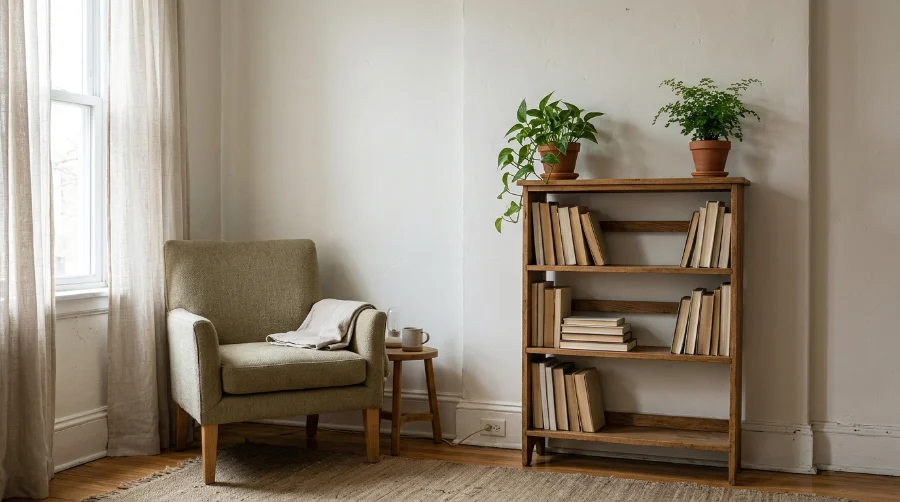
Books have a way of arriving faster than shelf space appears. A few bought on a weekend become a stack on the bedside table, the stack spreads to the floor, and the floor pile eventually moves under the bed where it is forgotten. In a small home the problem is sharper because every wall also has to serve seating, windows, and doorways. Adding another shelf is not always possible, and even when it is, a new surface tends to fill as quickly as the last one. The useful question is which books deserve the limited space that already exists.
A small home cannot keep every book that passes through it, so a choice has to be made somewhere. The least helpful rule is to keep everything and hope a corner appears later. A more workable approach judges each book by how often it is opened and by what it offers when it is opened. A cookbook used weekly earns its place easily. A novel that was enjoyed once and will never be opened again has a different claim, which is memory rather than use.
Both claims can be valid, but they should be recognized for what they are. Keep a small number of books for their personal meaning and be honest about the rest. Impulse keeps are the hardest category: a book picked up because it looked interesting often carries no strong attachment once it is home, yet it takes the same space as a favorite. Set these aside before deciding their fate; a short gap between choosing and storing makes the decision easier.
Consider the difference between a book that is read and a book that is intended to be read. The second kind can fill a small home quietly, because the intention feels like value. If a title has waited untouched through several moves or several years, it is reasonable to accept that the reading may never happen. Making room for what is actually used is not a judgment on taste; it is a practical response to limited space.
Once the keepers are settled, sort them by how often they are reached. This produces three useful tiers, and the tiers should not be mixed on the same shelf.
Books used every week belong between roughly waist and eye level. They are picked up without stretching, bending, or moving anything else. This tier is usually small, which is the point: the most convenient space is scarce and should not be spent on titles that sit untouched.
Occasional books can go higher or lower. A top shelf is fine for books taken down a few times a year, as long as a step or a sturdy stool is available and the stack is not heavy. Low shelves and the space under a bench suit larger volumes that are awkward to lift overhead. Heavy books belong low regardless of how often they are used, both for safety and for the stability of the unit holding them.
The third tier holds books kept but rarely handled. These can live in a less convenient spot: the top of a wardrobe, a labelled box under the bed, or a closed cupboard in another room. The mistake is putting a frequently used book there because it looks neat. Convenience should follow habit, not appearance.
Vertical storage is the familiar choice, and it has clear strengths. Spines can be read at a glance, a book can be slid out without disturbing its neighbors, and a row of upright books uses wall height efficiently. The cost is that a full-height gap is needed, and the row needs support. Without bookends or a filled shelf, books lean, and leaning leads to damaged covers and a shelf that looks untidy no matter how it was arranged.
Horizontal stacking solves different problems. Short stacks fit under tables, on window ledges, and above door frames where a standing book would not fit. They are stable for heavy volumes and can display an attractive cover. The drawback is discovery: only the top book in a stack is identifiable, so a pile becomes a place where titles disappear. Horizontal stacking works best for small groups that are deliberately chosen, not for a general collection.
Many small homes use both. Standing rows hold the everyday tier where browsing matters, while flat stacks hold oversized books or the few volumes kept for display. Keep flat stacks low enough that the top book does not slide, with the heaviest at the bottom. Mixing orientations at random makes a shelf harder to scan.
Open shelving makes books easy to browse and adds warmth, but it exposes them to dust, direct light, and visual clutter. In a small room, a wall of varied spines can feel busy, particularly when shelves also hold other objects. Closed storage creates a calmer background and protects books from sunlight and dust, at the price of hiding the collection behind a door.
A workable compromise is to display a small rotating selection and keep the rest closed. Choose the books that are currently being read or the ones with covers worth seeing, and change them occasionally. The displayed group stays small enough to look intentional, while the main collection remains protected. This also reduces the amount of dusting required, which matters in a home where time and space are both limited.
Rented homes add another consideration. Freestanding units move when a lease ends, and narrow shelves fit beside furniture that cannot be shifted. Before fixing to a wall, check that it is permitted and that the wall can take the loaded weight. A shelf full of books is heavier than it looks.
Several spots hold books well without taking over a main wall. The space under a bed suits shallow boxes on wheels, provided they clear the frame and the area stays dry. Above a doorway, a shallow shelf can hold light, rarely used volumes, though nothing heavy should sit overhead. The top of a wardrobe, the area under stairs, and a deep window alcove work if the depth suits a book's spine.
Measure before filling these places. A typical paperback needs far less depth than a large hardback, and an extra inch of clearance prevents books from being forced in at an angle. Check that doors open past the shelf, that drawers are not blocked, and that the spot is away from radiators, damp outside walls, and strong sunlight. Avoid blocking air vents or a heating grille with a tall unit; a shelf that stops airflow can create a damp patch behind it.
Weight deserves attention in hidden spots. A box of books under a bed should be light enough to slide out, and a shelf fixed above head height should hold only what can be lifted safely. If a space requires a ladder for a single book, it is probably better used for something else.
Every small home reaches a point where more books mean less living space. That point is personal, but it is real. A useful way to find it is to look at the total length of shelving available and compare it with the books that are genuinely used and valued. When the two no longer match, something has to move on.
Libraries, loans, and digital copies take pressure off a small collection without losing access to reading. A one-in, one-out habit works for households that acquire books steadily: a new arrival earns its place by releasing an older one. Others prefer to keep a fixed number and choose from it deliberately for a season.
The aim is not an empty room. A home with a few well-chosen books within easy reach is more pleasant than one where stacks spread across every surface. Let the collection fit the space, rather than reshaping the space around a collection that keeps growing.
Guides that pair well with this one.
Almost every home has one drawer that defeats every good intention. It holds batteries beside takeout menus, a lonely screw next to three unmatched rubber bands…
A drop zone is not really a piece of furniture. It is a defined place where the things you carry every day land before they spread through the rest of the house. In…
A donation bag left in a closet usually stays there. The idea was sound, but the bag was out of sight and nobody had to pass it. A donation station works better…