Home Organization
A Junk Drawer That Doesn't Refill Itself
Almost every home has one drawer that defeats every good intention. It holds batteries beside takeout menus, a lonely screw next to three unmatched rubber bands…
A small laundry room rarely fails because it is too small. It fails because it is asked to be four rooms at once: a place to wash, a place to dry, a place to fold…
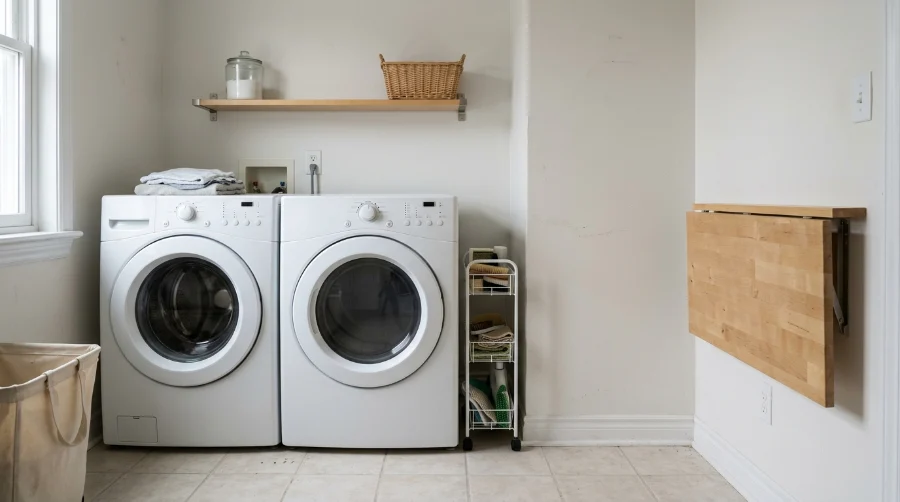
A small laundry room rarely fails because it is too small. It fails because it is asked to be four rooms at once: a place to wash, a place to dry, a place to fold, and a place to keep everything from dog food to spare light bulbs. Sorting the room properly starts with deciding which of those jobs actually belong there.
Before moving a single basket, stand in the room and name its real role. A laundry room that leads straight to the garden may be a muddy-boots stop. One off a hallway may be a household store cupboard that happens to hold a washer. Neither description is wrong, but each calls for a different layout.
The most useful question is what already gets dropped in the room every day. If clean clothes pile on the machine while clean towels end up in the kitchen, the room is being used for washing but not for finishing. That gap matters more than any shelf. A room given one clear job can stay tidy with very little equipment; a room given four vague jobs will collect clutter no matter how many baskets are bought.
Write the answer down and keep it somewhere visible during the setup. When a decision comes up later — whether a mop bucket fits, whether the ironing board belongs here — measure it against that sentence. It is much easier to say no to an item when the room has a stated purpose.
Everything that is used at every wash deserves to be within one arm's reach of the machine. That usually means detergent, a measuring scoop or pods, and a stain stick. Keep them together in a single container that can be lifted down and put back with one hand. A tray or a shallow box works better than a shelf for this, because nothing disappears behind a row of bottles.
Most household machines are roughly standard in size, but door swing and lid direction change how much space is truly usable. A front-loading door needs room to open fully, and a top-loading lid needs clear space above it. Before adding a shelf directly over a machine, check the owner's manual for the clearance the manufacturer recommends. A shelf that interferes with the lid or the door will be removed within a week.
One detail that is easy to overlook is the space beside the machines, not above them. A narrow gap of eight to twelve inches can hold a slim rolling cart with supplies on top and a hamper below. That is often more useful than a high shelf reached only with a stool.
In small homes, folding happens wherever there is a free surface — the kitchen table, the bed, or the top of the dryer. If the laundry room can spare even a narrow ledge, folding there stops clean clothes from migrating through the house. A fold-down board fixed to the wall takes almost no space when closed and gives a firm surface when open.
If there is no room for a permanent surface, keep a flat basket that can be lifted off a shelf and set on top of the machine briefly. The point is not to build a folding station; it is to make sure clean laundry has somewhere to land besides the floor. A room that handles washing but offers nowhere to put the result will always look half-finished.
Laundry rooms often become the default home for every cleaning product in the house. That is convenient until the shelf above the washer holds bleach, floor spray, and a pile of pet food, and nobody wants to reach past one to get the other. Keep laundry products in one group and household cleaning products in another, even if the two groups sit on the same wall.
Use containers that are clearly different from each other, and never decant a cleaner into a food container or an unmarked bottle. Keep products in their original packaging where possible so the instructions stay readable. Anything that must be kept away from children needs a latch or a high shelf, and that rule should be decided before the shelving goes up, not after.
Pet food and laundry products should not share a container or a scoop. If both must live in the same room, give each a closed bin with a distinct shape. Mixing them is not a theoretical risk; it is a common mistake in rooms that hold many similar-looking tubs.
Some laundry rooms are corridors. The door opens onto the washer, and everyone walks through to reach the garden or the garage. In that case, floor space matters more than wall space. A hamper in the middle of the route will be kicked, and a basket left by the door will be stepped around until it becomes a permanent obstacle.
Keep the walking line completely clear. Put hampers against the wall, choose slim bins over wide ones, and hang anything that can hang. If the room is narrow enough that a person has to turn sideways, resist the urge to fill every corner. The room may never look like a magazine photograph, but it will work every day.
A door that swings into the room can quietly remove a large amount of usable space. If the hinge can be reversed, do it before buying storage. Otherwise, measure the arc of the door with a piece of string and treat that arc as empty floor. Planning around the real door swing avoids the frustration of installing a shelf that the door hits.
A few fittings make a small laundry room work harder without adding clutter. A tension rod across an alcove holds hangers for shirts that should not go in the dryer. A hook on the back of the door holds a laundry bag. A single wall hook near the machine keeps a lint brush from disappearing into a drawer. Each of these uses space that is otherwise wasted.
Air drying needs careful thought in a damp room. A folding rack can be pulled out when needed and stored flat against a wall, but leaving wet clothes in a closed room for days encourages mildew. If the room has no window or fan, dry clothes elsewhere and use the laundry room only for the machine work.
The fastest way to spoil a small laundry room is to treat it as a general storeroom. Off-season decorations, broken toys, and half-used paint tins all seem reasonable to park there temporarily. Temporary storage in a working room becomes permanent within a month.
Spare paper goods may live in a laundry room if there is a closed cupboard, but only in a quantity that fits. One extra pack of toilet paper is useful; six are a stockroom. The same applies to cleaning refills. Keep what a normal week uses and store the surplus somewhere with more space.
Ironing equipment is another common source of clutter. A board that has to be unfolded and put away each time often ends up leaning in a corner for months. If there is no safe place to store it flat or hang it, consider whether a handheld steamer used in another room suits the household better.
The test of a good laundry room is not how it looks on the day it is organized. It is whether the household can return it to order in under two minutes after a busy wash day. That means fewer containers, fewer rules, and clear places for the three or four things that are used most often.
Once a week, remove anything that has drifted in and does not belong: a stray toy, a delivery box, a coat dropped on the way through. This short reset takes less effort than a full sort and prevents the slow drift that turns a working room into a dump. A small laundry room does not need more storage. It needs a clear purpose and a little space left empty.
Guides that pair well with this one.
Almost every home has one drawer that defeats every good intention. It holds batteries beside takeout menus, a lonely screw next to three unmatched rubber bands…
Craft and sewing supplies are difficult to put away because so much of them is small. Buttons, beads, threads, snaps, and scraps are easy to drop into a single…
A drop zone is not really a piece of furniture. It is a defined place where the things you carry every day land before they spread through the rest of the house. In…