Small Space Solutions
Cleaning Supplies That Stay Together and Safe
Cleaning products tend to spread across a small home because they are used in several places and bought one at a time. A bottle under the sink, a spray in the…
A hallway is usually treated as a corridor: a strip of floor between rooms that nobody stops in. In a small home, that strip is valuable space. Used well, it can…
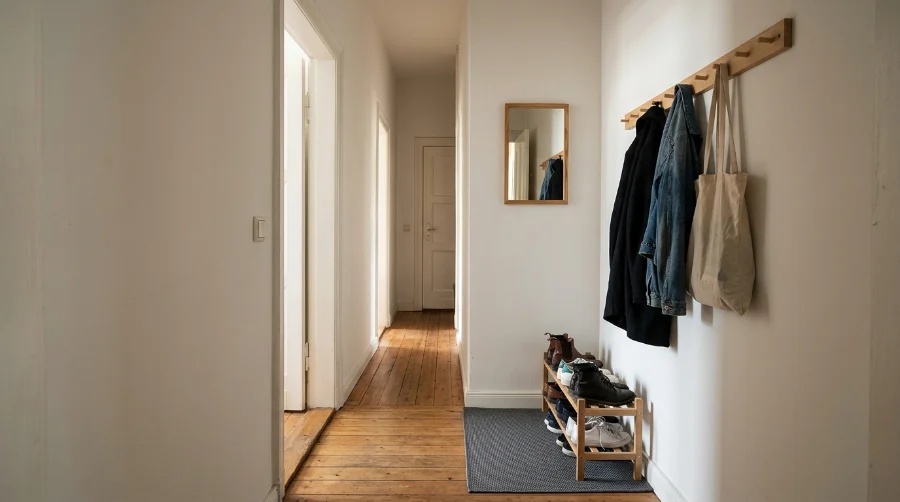
A hallway is usually treated as a corridor: a strip of floor between rooms that nobody stops in. In a small home, that strip is valuable space. Used well, it can absorb coats, shoes, post and the small items that otherwise collect on kitchen chairs. The challenge is to add storage without narrowing the route or turning the entrance into an obstacle course.
Before adding anything to a hallway, work out how much of it must stay clear. Measure the narrowest point and note where doors open into the passage. A hallway used as the main route needs enough width for a person to walk while carrying something, and it must remain safe in an emergency. That clear line takes priority over any storage idea.
Mark the route mentally from the front door to the rooms beyond. Anything placed in that line becomes a daily irritation. The usable storage areas are the walls, the space above head height, and any recess or alcove that sits outside the walking path.
Floor-standing furniture eats the width of a narrow hallway. Wall-mounted storage leaves the floor open. A shallow rail with hooks holds coats and bags at hand height, while a shelf above it can take items that are not needed every day. Even a few centimetres of depth is enough for a narrow ledge holding keys or a small tray.
Fix shelves and rails into studs or solid masonry where possible. Hallway walls take a surprising amount of use, and light fittings attached only to plasterboard may pull loose. Choose hooks with a rounded end so bags do not snag, and vary their height if children share the home.
Loose shoes are the fastest way to make a hallway look untidy. A low, shallow shoe rack keeps pairs together and lifts them off the floor, making cleaning easier. If the hallway is too narrow for a rack, a wall-mounted shoe rail or a set of stacked boxes tucked into a recess can do the same job.
Limit the number of pairs kept in the hallway to those worn regularly. Boots and wet outdoor shoes need a spot where they can dry without marking the walls, ideally on a washable mat. Keeping a small mat by the entrance protects the floor and gives wet shoes an obvious place to land.
Many hallways are dark because the only light is at one end. A dark passage feels narrower than it is and hides the things stored there. A simple wall light, a battery-operated motion light, or a ceiling fitting with a bright, even bulb makes the whole area feel larger and safer.
If wiring is not an option, a rechargeable light that comes on when someone passes is a practical alternative. Place it so it lights the walking route rather than shining directly into the eyes at door height. Good light also makes it easier to find keys and read a label at a glance.
A mirror on one wall can make a narrow hallway feel wider and gives a last check before leaving. Hang it where it reflects light rather than a pile of shoes, and secure it firmly since hallways are busy spaces. A light wall color helps in the same way, though the effect is modest compared with clearing clutter from the floor.
Color can also define the hallway as a distinct zone in an open-plan home. A slightly deeper shade on the walls, or a runner along the floor, signals that this is a passage rather than an extension of the living room. Keep patterns restrained so the eye is not confused in a tight space.
Even a narrow hallway can hold one shallow surface for the items that come in and out daily. A floating shelf or a narrow console of no more than a foot in depth provides a home for keys, a wallet or a small tray for post. The surface should be just wide enough for those essentials; a deeper table becomes a dumping ground.
Give the surface a rule: it holds things in transit, not things in storage. A weekly clear-out keeps it from becoming a second junk drawer. If post or paperwork tends to pile up, pair the shelf with a single wall pocket so papers have somewhere more deliberate to go.
One common error is filling every centimetre of wall. A hallway crowded with hooks, shelves and frames feels smaller than an empty one. Leave stretches of plain wall so the eye has somewhere to rest, and hang only what the household uses. Empty space is part of what makes a narrow passage comfortable.
Another is ignoring how doors and drawers move. A shelf placed just where a door swings will be knocked repeatedly, and a shoe box under a coat rail may block a cupboard. Open every door and pull out every drawer in the hallway before fixing anything in place.
A hallway that works for the whole household accounts for different heights and mobilities. Low hooks let children hang their own coats and bags without help, while a bench with a raised seat gives an older resident a place to sit while putting on shoes. If a seat is added, measure the remaining width carefully, since even a narrow bench can close a tight passage. Keep the floor free of loose mats with curled edges, which are a trip hazard in a route used in a hurry.
A small hallway cannot become a storage room, but it can do useful work. Keep the walking route clear, move storage onto the walls, give shoes and daily items a defined home, and light the passage properly. Those four changes turn a corridor into a small but genuinely functional part of the home, without costing the space it needs to remain a route.
Guides that pair well with this one.
Cleaning products tend to spread across a small home because they are used in several places and bought one at a time. A bottle under the sink, a spray in the…
A home office in a small room works best when it is planned as a room within a room. The desk is only one part of it. You also need enough space to pull out the…
A small balcony is often asked to do two jobs at once. It needs to be a place to sit outside, and it quietly becomes the home for things that do not fit indoors…