Small Space Solutions
A Mudroom Corner in a Home Without a Mudroom
Shoes, wet coats, and muddy gear arrive through the same door every day, and in many homes there is no room set aside to receive them. Without a defined spot, boots…
Baby gear has a way of arriving faster than any storage plan can keep up with. A single purchase soon turns into a stroller frame, a car seat base, a bag of…
Baby gear has a way of arriving faster than any storage plan can keep up with. A single purchase soon turns into a stroller frame, a car seat base, a bag of accessories, and a stack of clothes in three sizes before the first month is over. Much of it is bulky, and a surprising share is only useful for a short stretch. The goal in a small home is not to find a permanent place for everything, but to keep what is in use close at hand while the rest waits quietly until it is needed again, or leaves the house altogether.
Begin by dividing everything into three groups: what the baby uses now, what belongs to the next stage, and what has already been outgrown. This works better than sorting by item type or by the room a thing happened to land in. A small home cannot afford to give prime space to something that will not be opened for six months. Put the current group where daily life happens, keep the next group small and contained, and deal with the outgrown group first, since it is the one taking up space without earning it.
Be realistic about the next group. It is tempting to hold on to every outfit and gadget in a waiting pile, but most households only need a narrow band of sizes ahead of them. One or two sizes forward is usually plenty; beyond that, clothes can stay packed in a labelled bag or with a relative who will use them sooner. The same applies to equipment. A second high chair reserved for a future child is a decision to store a large object for years, and that is a choice worth making deliberately rather than by default.
Once a stage ends, the gear should not linger in daily space. Clean it, check that nothing is missing, and place it in a container marked on the outside with the size or age range it suits. Keeping one container per stage is far easier than maintaining a pile of loose bags, because the whole thing can be moved, stacked, or handed on in one action. Small accessories belong with the item they support: straps with the seat, shields with the high chair, spare parts in a sealed pouch inside the same box.
Store these containers in a single spot instead of spreading them across several rooms. A clothes rail in a wardrobe, the space above a cupboard, or the back of a built-in closet can all work, provided the boxes are light enough to lift down safely. Keep heavier items at low or waist height and reserve high shelves for soft goods such as outgrown clothing and blankets. A rotation only helps if it is visible; a clear label on the front means nobody has to open three boxes to find the right size.
Resist the pull to keep everything. Gear that is damaged, incomplete, or no longer safe has no place in a future pile, however carefully it was stored. If an item cannot be passed on in good conscience, it should be recycled or discarded rather than occupying a box that could hold something useful.
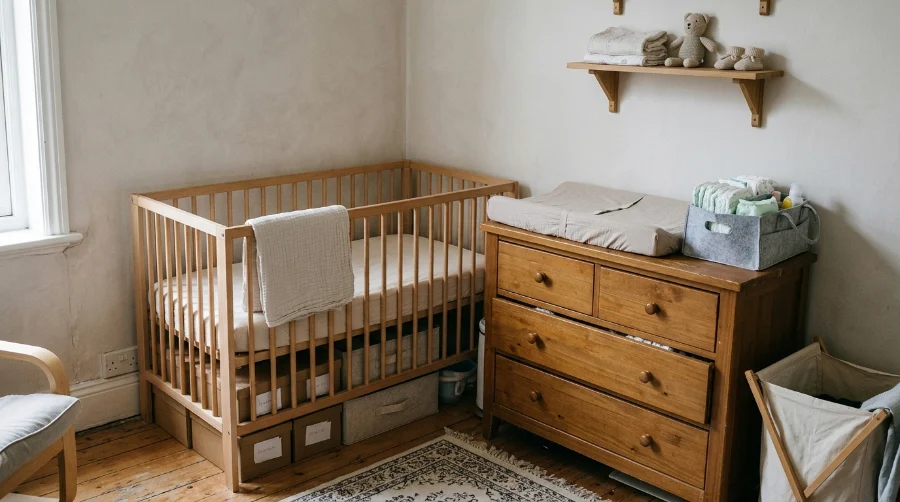
In a small room, floor space is the first thing to run out, so look upward with care. Wall shelves are suitable for light items such as spare bottles, soft cloths, and neatly rolled clothing, but they are not the place for heavy equipment. Anything mounted high must be fixed properly into a stud or with fixings rated for the weight, because a shelf that falls is a genuine hazard near a cot or changing area. Where drilling is not an option, a tall narrow bookcase with a wide base can provide similar storage without the same commitment.
The space under a cot is useful for flat, shallow boxes that slide out fully, though it is better suited to bedding and clothing than to awkward-shaped equipment. Furniture that does two jobs earns its footprint: a chest of drawers that becomes a changing surface, a low ottoman that stores nappies while serving as a seat, or a rail that holds a small wardrobe under a sloping ceiling. Choose pieces with smooth surfaces and rounded edges where possible, since a baby pulls on everything within reach. A single multi-purpose item is almost always better value in square meters than two single-purpose ones.
Things used ten times a day deserve the shortest reach. Nappies, wipes, a change of clothing, and a few dummies should sit near the changing spot rather than in a cupboard across the room. A shallow caddy or small basket works well because it can be carried one-handed and tucked back into place just as quickly. Refill it from the main store rather than moving the whole supply into the room at once; a full month of nappies beside the changing mat will crowd out everything else.
Feeding items need the same treatment. Keep the bottles, cups, and cloths used at every feed together, and store the extra stock elsewhere. It is tempting to create a beautiful display of everything at once, but a display is not the same as a working system. One small open basket for the items in current use, with a closed container for backups, keeps the area usable when the baby is awake and the adult holding them has only one free hand.
Baby gear brings a few hazards that ordinary household storage does not. Straps on car seats, carriers, and bouncers should be shortened or loosely coiled so they cannot catch on a drawer handle or drape where a child could become tangled. Never hang or rest heavy items above a cot or changing area, even for a moment, and avoid placing a loaded shelf directly over a spot where a baby is lifted. Small parts such as replacement screws, bottle teats, and toy pieces belong in sealed containers kept well out of reach, because they are easy to misplace and just as easy to swallow.
Any furniture that a child can climb or pull on should be secured against tipping, including drawers, bookcases, and changing units. Keep gear away from radiators, heaters, and direct sun, since heat can damage plastic and fabric over time. Finally, check stored equipment before it is used again: latches, seams, and straps can degrade in storage, and a second child should never inherit a item that has not been looked over first.
A rotation works only when items actually leave. Decide early what happens at the end of each stage: passed to a sibling, loaned to a relative, donated to a local family, or sold on. Write the destination on the container while the decision is fresh, because a box labelled simply "baby things" tends to stay in the house indefinitely. A short note is enough: where it is going and roughly when.
Set a review point every few months, perhaps when the seasons change or before a birthday, and open the stored boxes with a clear purpose. If nothing in the future group has been touched in a year, the household is almost certainly keeping more than it needs. Letting go of a item does not mean discarding it; in most cases it means giving another family the use of something that has plenty of life left. The reward is not a tidier shelf for its own sake, but a home where the baby's things fit around family life instead of taking it over.
Guides that pair well with this one.
Shoes, wet coats, and muddy gear arrive through the same door every day, and in many homes there is no room set aside to receive them. Without a defined spot, boots…
Line drying outdoors is not an option in every season or every home. Rain, cold, pollen, a shared balcony, or the lack of a yard can all make it impractical, and…
A home office in a small room works best when it is planned as a room within a room. The desk is only one part of it. You also need enough space to pull out the…