Small Space Solutions
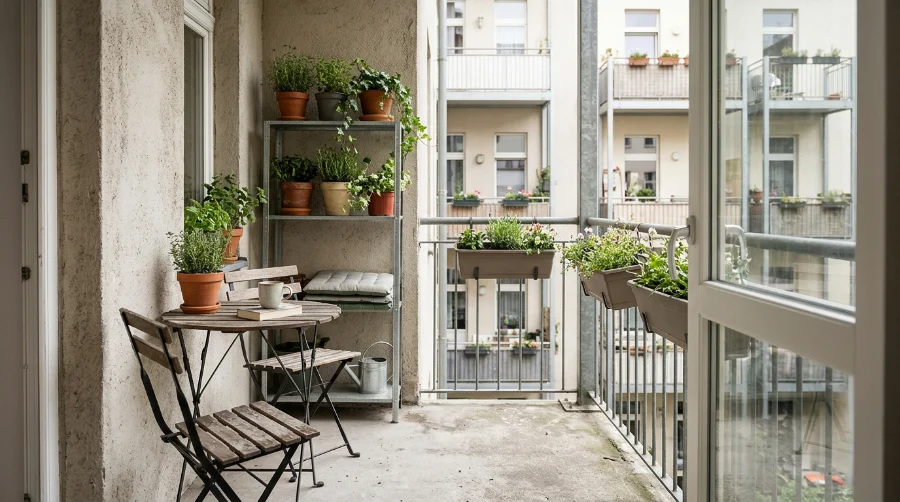
A Small Balcony That Seats and Stores
A small balcony is often asked to do two jobs at once. It needs to be a place to sit outside, and it quietly becomes the home for things that do not fit indoors…
A home office in a small room works best when it is planned as a room within a room. The desk is only one part of it. You also need enough space to pull out the…
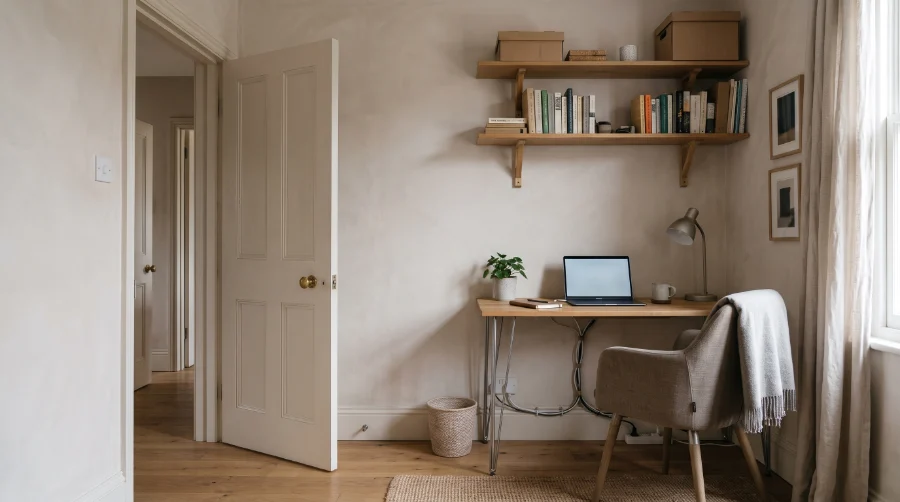
A home office in a small room works best when it is planned as a room within a room. The desk is only one part of it. You also need enough space to pull out the chair, somewhere for the door to open, and a way to stop work from spilling into every corner when the door is closed.
Start with the desk. A depth of around 24–30 inches (60–75 cm) suits most computers and writing tasks, while a shallower desk may be enough for a laptop only. Check the width against the wall you plan to use, and leave a little space at each side for a lamp or a notebook.
The more important measurement is what happens behind the desk. Allow roughly 36 inches (90 cm) from the desk edge to the nearest obstruction so the chair can move and a person can stand up comfortably. If that space is not available, a wall-mounted or folding desk becomes more attractive than a fixed one.
Open the door fully and note where it stops. A desk placed behind the swing may technically fit but will be irritating every time someone enters. The same applies to a wardrobe door or a radiator that projects into the room.
If the room has a window, placing the desk beside it often gives better light than facing it directly. Facing a bright window for hours can be tiring, while side light is usually easier on the eyes. Add a lamp for darker days and for evening work rather than relying on the window alone.
In a room used only occasionally, a folding desk or a drop-leaf table can appear when needed and disappear afterwards. In a room used every day, a fixed desk is less work. The choice depends on how often you sit down to work, not on how small the room looks.
A narrow desk along one wall leaves the center of the room open. A corner desk uses two walls but often needs a deeper footprint than people expect. Before buying one, measure both walls and check that the corner is square enough for the unit to sit flush.
When the floor is limited, walls become storage. A couple of shelves above the desk can hold reference books and a few boxes. Keep frequently used items at eye level and rarely used ones higher. Open shelves are easy to reach but need regular tidying; closed cabinets hide clutter but take more visual space.
A pegboard or a simple rail can hold headphones, cables and small tools. Use hooks with a purpose rather than filling every hole. In a small room, visible order looks calmer than a crowded wall of gadgets.
Cables look worse and become harder to unplug in a tight space. Group them behind the desk with a simple clip or a cable tray, and label both ends if several similar leads are used. Leave enough slack for the chair to move without pulling a plug out.
If power sockets are inconvenient, a surge-protected extension strip fixed under the desk is tidier than one lying on the floor. Keep the strip accessible so it can be switched off, and avoid running cables under a rug where they can overheat.
A small office can still be uncomfortable if the chair and screen are badly placed. The top of the screen should be roughly at eye level, and the chair should let your feet rest flat while your elbows stay near the desk. A footrest or a cushion may help if the desk height cannot be adjusted.
Ventilation matters too. A closed room with a computer and a person in it warms up quickly. Keep a window open when weather allows, or use a small fan rather than working in stale air. Comfort is not a luxury here; it determines whether the space gets used.
Many small rooms are also guest rooms, craft rooms or storage areas. Give each job a defined zone, even if the zones are only a shelf and a corner. When work ends, put the laptop away and clear the desk if the room will be used for something else that evening.
A folding screen or a curtain across a closet office can hide the workspace when visitors arrive. It does not add floor space, but it changes how the room feels. That matters if the room is also used for relaxing.
A small room does not automatically make a good workspace. If others are nearby, sound travels and calls become difficult. A door that closes is the simplest solution. Where that is not possible, place the desk so your back is to the busiest part of the home, and use a soft furnishing such as a curtain or a fabric panel to reduce echoes.
Headphones are useful, but they are not a plan for every hour. Let the people in the home know when you need uninterrupted time, and keep those periods short and predictable. Clear boundaries work better than asking for silence all day.
Each of these problems is easier to fix at the planning stage. A sheet of paper with the room drawn to scale can prevent most of them.
A narrow desk, a comfortable chair, one lamp and a shelf may be all the office you need. Use that for a few weeks before adding anything. Notice what you reach for often and what never leaves its box. Build around real habits, and the small room will feel like a workspace rather than a storage area with a computer in it.
Guides that pair well with this one.
A small balcony is often asked to do two jobs at once. It needs to be a place to sit outside, and it quietly becomes the home for things that do not fit indoors…
Cleaning products tend to spread across a small home because they are used in several places and bought one at a time. A bottle under the sink, a spray in the…
A hallway is usually treated as a corridor: a strip of floor between rooms that nobody stops in. In a small home, that strip is valuable space. Used well, it can…