Small Space Solutions
A Home Office That Fits in One Small Room
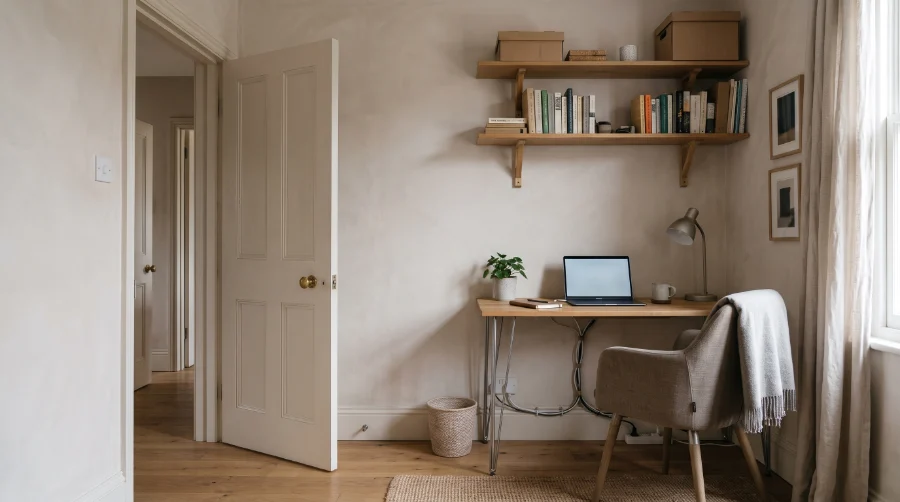
A home office in a small room works best when it is planned as a room within a room. The desk is only one part of it. You also need enough space to pull out the…
A small home gym fails for predictable reasons. The space is usually available, but it is given too much equipment, too little clearance, or no plan for returning…
A small home gym fails for predictable reasons. The space is usually available, but it is given too much equipment, too little clearance, or no plan for returning to normal life after a workout. Avoiding those errors matters more than buying the right mat.
The most common mistake is choosing equipment first and finding a place for it later. A treadmill, a rowing machine, or a weight bench has a working footprint that is larger than its stored size. A machine that fits against a wall may need several feet of clear space behind it when in use.
Measure the room, including the door swing and any radiators, then mark the working footprint of each item on the floor with tape. Live with the outline for a few days. If the space cannot be walked through comfortably, the equipment will be used less often, no matter how good it is.
Check the ceiling height as well as the floor. Overhead presses or a tall elliptical may need more vertical space than expected, especially in a converted room or a basement with low beams.
Small spaces punish excess. A full set of dumbbells, a bench, a mat, a bicycle, and resistance bands all promise variety, but each one needs a home. When the room becomes crowded, getting started feels like work, and the gym quietly stops being used.
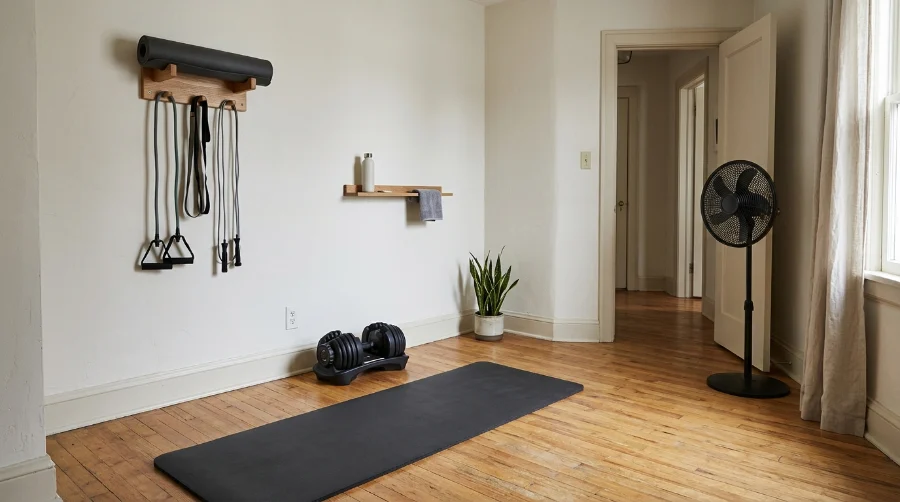
Most households do better with a small core of versatile items. A pair of adjustable weights, a mat, and one form of resistance equipment cover a wide range of exercises. Add a second item only when the first set is used consistently and the room still has clear floor.
Multi-function machines seem efficient but often are not. A unit that promises ten exercises may take up more space than three simple items and be slower to adjust between movements. Simplicity wins in a small room.
Dropping weights on a hard floor damages both the floor and the equipment, and it creates noise that travels to other rooms. A thick mat protects the surface and reduces impact, but it must be large enough for the movement being performed. A small mat under a bench does nothing for the area where weights are lifted.
Think about neighbors and other household members before choosing high-impact activities. Jumping exercises in an upstairs room are a common source of complaint. Low-impact alternatives, such as cycling or strength work, cause far less disturbance and are easier to fit into a shared home.
If the room is above a living area, place equipment away from the lightest part of the floor and use a dense underlay where weights are set down. Check with the building's rules if the property is leased or part of a shared development.
In most homes, a gym shares space with something else: a guest bed, a desk, or a store cupboard. The mistake is assuming the room can be converted in a few seconds. A fold-out bed with items piled on it cannot be opened quickly, and a desk covered in equipment is not a desk.
Give shared rooms a clear reset. Keep workout items in one container or on one rack so they can be moved aside together. A folding mat and a pair of weights stored in a single box take a minute to put away; the same items scattered across the room take much longer.
If the space doubles as a work area, keep the two uses visually separate. A rug or a change in lighting can signal that the room has switched purpose. This matters because the mind responds to the room as much as the body does.
A small room heats up quickly during exercise. Without airflow, a workout becomes uncomfortable and the room holds moisture and smells. A window that opens, a fan, or a simple air circulator makes a real difference, especially in a garage or a converted room.
Avoid sealing a small gym completely for privacy. If the room has a door, leave a gap when exercising or fit a vent if the door must stay closed. In a damp space, moisture from breathing and sweat can settle on walls and equipment, so wipe surfaces down after heavier sessions.
Enough space around equipment is a safety requirement, not a comfort. A person lifting weights needs room to step back, and a machine in motion needs clearance on the side where it is mounted. Crowding a room with other furniture removes that margin.
Secure any equipment that can tip, especially if children are in the home. Free weights should be stored on a low rack with heavier items at the bottom. Resistance bands should not be left where they can be stepped on, and any cable machine needs a check of its attachments before use.
Keep a small first aid kit and water in the room. This is not a sign of caution taken too far; it simply means a minor problem does not require crossing the house mid-session.
Storing equipment where it is used is convenient but can crowd the floor. A wall rack works well for mats, bands, and light weights, provided it is fixed into suitable fixings and not into loose plaster. A narrow shelf for water and towels keeps the floor clear.
Do not put a mirror directly opposite a machine where it will distract or reflect harsh light. A mirror can help with form, but it should be placed where it is useful rather than where it fills a blank wall.
Another common error is leaving the equipment arranged for the ideal workout rather than the realistic one. If a bench stays set up but blocks the path to a cupboard, it will be moved constantly. Store large items against a wall and set them up only when needed.
The best small home gym is the one that gets used. Begin with a mat and a small set of weights, place them where they can be reached, and add nothing for a month. If the space still works and the routine holds, add one more item. Most people find that less equipment than expected is enough.
Avoiding these mistakes is not about creating a perfect training room. It is about removing the small obstacles that make a workout feel like a chore. Clear floor, sensible storage, safe setup, and a plan for sharing the space will do more for consistency than any advanced machine.
Guides that pair well with this one.
A home office in a small room works best when it is planned as a room within a room. The desk is only one part of it. You also need enough space to pull out the…
Baby gear has a way of arriving faster than any storage plan can keep up with. A single purchase soon turns into a stroller frame, a car seat base, a bag of…
A small balcony is often asked to do two jobs at once. It needs to be a place to sit outside, and it quietly becomes the home for things that do not fit indoors…