Bathroom Ideas
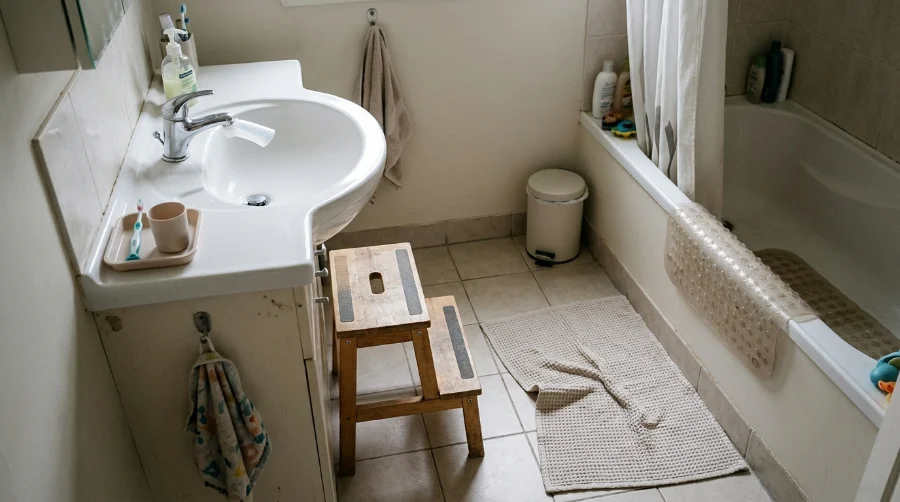
A Bathroom Set Up at a Child's Height
A bathroom designed for adults assumes a user who can reach the tap, judge hot water, and step over the bath edge. Children can do none of these reliably. Setting…
Few rooms have less give than a small bathroom. The door, the toilet and the shower all need clear space, and there is usually no spare corner for a cabinet. Good…
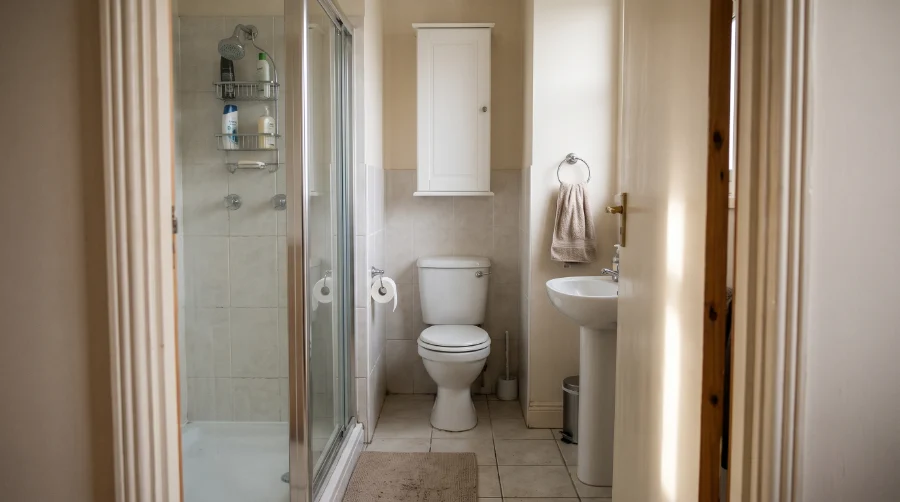
Few rooms have less give than a small bathroom. The door, the toilet and the shower all need clear space, and there is usually no spare corner for a cabinet. Good organization here is mostly about deciding what needs to be within reach and letting everything else go.
Before adding a shelf or a basket, check how the door opens and how much floor is left in front of the toilet. Many building guidelines use about 21 inches (53 cm) of clear space in front of a toilet as a minimum, and more is comfortable in a household with children or older adults. Check local rules before making permanent changes, but use that figure as a starting point for planning.
A freestanding unit that fits on paper may block the door once it is installed. Measure the swing, including the handle, then mark the floor with tape if you are unsure. If the space is tight, wall-mounted storage is safer than anything that sits on the floor.
Think of the bathroom as three small work areas: the sink, the shower or bath, and the toilet. Each needs its own small supply of items. Toothbrushes, soap and face cloths belong at the sink. Shampoo, conditioner and a razor belong in the shower. Toilet paper belongs within arm's reach of the toilet, not across the room.
This sounds obvious, but many small bathrooms are organized around a single cabinet that is too far from two of those areas. Duplicating a few inexpensive items, such as a second hand soap or a spare roll of toilet paper, is often better than making people walk in and out with wet hands.
The wall above a toilet is one of the few unused areas in a small bathroom. A narrow shelf or cabinet can hold towels, toilet paper and cleaning supplies. Leave enough height for an adult to sit without hitting their head, and keep the unit shallow so it does not feel as though it hangs over the room.
Do not store anything heavy or glass on an open shelf above the toilet. A falling bottle is a real hazard. Closed cabinets are safer for anything not used every day. If the wall is not suitable for drilling, a freestanding rack designed for toilets can work, but check that it does not wobble.
Shampoo bottles on the floor of a shower become a slipping hazard and collect grime. A hanging caddy or a corner shelf keeps them off the floor and lets them drain. Choose a caddy that can be removed and rinsed; a fixed shelf that cannot be cleaned properly will grow mould at the edges.
Hooks inside the shower area can hold a shower cap or a washcloth, but they need to dry out between uses. A tension rod across the bath can hold a curtain for drying items, although it only works if the room has enough ventilation. If the bathroom has no window, run the extractor fan after showers and avoid hanging damp fabric in a closed room.
Bathrooms are damp, so closed plastic tubs are not always the best choice. A basket with open weave or a tray with drainage holes lets air move around towels and bottles. If you use closed bins, take the contents out once a week and let the space air out.
Use fewer containers than you think you need. A single tray under the sink that can be pulled out whole is easier to maintain than five small boxes, each with a lid that has to be lifted. Group items by the task: one tray for cleaning, one for first aid, one for hair care. Label only where the contents are not obvious.
Towels take up more room than most small items, so decide how many the bathroom actually needs. Two hand towels and one bath towel per regular user is usually enough when they are changed often; a large stack in a small bathroom usually means somewhere else in the home is short of storage. Fold them to the size of the shelf instead of forcing an oversized pile into a narrow cupboard.
A towel ring beside the sink works better than a bar across the room, because wet hands do not have to travel far. Leave a little space between the ring and the wall so the fabric can dry. If the room has a radiator, check that it is safe to place a towel over it before using it that way.
Not every item belongs in a bathroom. Medication should stay in a cool, dry place, since heat and humidity can affect it. Electronics, paper documents and spare batteries should be kept elsewhere. Perfume and cosmetics that dislike heat are better stored in a bedroom or a drawer away from the shower.
Keep cleaning products together and away from toothpaste and towels. If they must share a cupboard, use a closed container with a clear label so nobody reaches for the wrong bottle. Never mix cleaning products in the same container.
If the room has no bin elsewhere, a small lidded one for used tissues and cotton pads is worth the space. Empty it regularly rather than letting it overflow onto the floor.
A small bathroom works best when the floor is clear and the items you use daily are visible. Put rarely used things away, but do not hide everything behind a door that is difficult to open. A few simple habits do more than a full set of matching containers:
When the room starts to feel crowded, remove an item rather than adding another organizer. In a bathroom with almost no spare space, less stuff is the most reliable form of storage.
Guides that pair well with this one.
A bathroom designed for adults assumes a user who can reach the tap, judge hot water, and step over the bath edge. Children can do none of these reliably. Setting…
A powder room is usually a small space used by guests and family for quick visits. Because it has no shower or bath, the layout can be simpler than a full bathroom…
Towels are bulky, and a small bathroom rarely has a good place for them. Left on a hook behind the door, they stay damp and never quite dry. Piled on a shelf, they…