Home Decorating
Curtain Details That Change a Small Room
Curtains do more than cover a window. In a small room they affect how much daylight comes in, how wide the window appears and how much visual space the wall seems…
A mirror is one of the few decorating choices that can change how large a room feels without moving a single piece of furniture. It works by reflecting light and by…
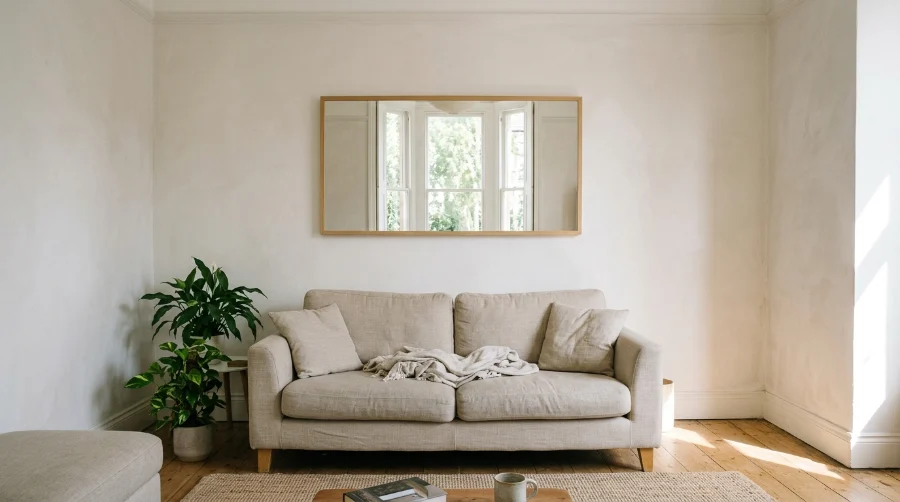
A mirror is one of the few decorating choices that can change how large a room feels without moving a single piece of furniture. It works by reflecting light and by giving the eye somewhere to continue past the wall. Placement matters far more than size, and a well-positioned small mirror often does more than a large one hung in the wrong place.
Before choosing a spot, look at what the mirror would face. A window, a light wall, or a view into the next room will brighten the space and create a sense of depth. A blank wall, a dark corner, or a pile of clutter will simply repeat the problem twice.
A mirror opposite a window is effective because it carries daylight deeper into the room. This works even when the window is modest. The reflected light softens shadows and makes the room feel less enclosed. If the window faces a busy street or an unattractive view, angling the mirror slightly can keep the light while reducing what is reflected.
A mirror facing a doorway can suggest that the room continues beyond its walls. This is useful in a small hall or a narrow living room. Test the angle from the usual seating position rather than from the doorway, since that is where the effect is most often noticed.
Hang a mirror so that its center is around eye level, or slightly above it if it sits over a piece of furniture. A mirror hung too high reflects the ceiling and adds little. One hung too low reflects the floor and can feel awkward in a seated room.
In a hallway, a full-length mirror is practical as well as useful for the sense of space. In a living room, a wide mirror above a console or a sideboard works better than a tall narrow one, because it spreads light across the wall. In a bedroom, a mirror on the inside of a wardrobe door can be used when needed and hidden the rest of the time.
Where a mirror is reflected in another mirror, the effect can be uncomfortable. Two mirrors facing each other create repeating reflections that make a small room feel busy rather than open. Avoid this unless the effect is intentional.
A large mirror can look impressive but needs a wall that can hold it. If the frame fills most of the space between a doorway and a corner, the room may feel crowded rather than expanded. Leave some plain wall around the mirror so it reads as an object rather than covering the surface.
Several small mirrors grouped together can work in a narrow space where one large frame would not fit. Keep a shared element, such as the same frame color or shape, so the group looks deliberate. A cluster of mismatched mirrors often creates visual noise.
Frameless or thin-framed mirrors feel lighter in a small room. A heavy, dark frame can dominate a wall and draw attention to the mirror itself. A simple frame lets the reflection do the work.
A mirror placed near a lamp can double the effect of the light, which is useful in the evening. Position it so the lamp is reflected softly rather than as a bright glare. A mirror directly opposite a bare bulb will make the light harsh, so use a shade or move the lamp slightly.
In a room with one window, a mirror on the wall beside it can spread light across the side of the room that stays dark. This is often more effective than adding another light source. A mirror on the wall perpendicular to the window catches light without reflecting the view straight back out.
Keep the mirrored surface clean. Dust and smears are more noticeable on a mirror than on a painted wall, and a dull surface reflects less light. Clean it with a suitable cloth and avoid spraying liquid directly onto the edges, where moisture can damage the backing.
In a narrow hallway or a small entry, a mirror on the wall beside the door can make the passage feel wider. Placing it on the longer wall reflects the length of the hall and draws the eye along it. A mirror at the far end works differently, suggesting that the space continues beyond the wall.
Stairwells and landing areas benefit from the same approach, provided the mirror is fixed securely and out of the path of people carrying things. In a small dining area, a mirror on the wall behind the table can reflect the room and soften the feeling of a tight space. Keep the surface at a height where seated people see light rather than the ceiling.
Do not place a mirror where it will be bumped. A hall mirror close to a door, or one above a worktop where people reach regularly, may be knocked or cracked. Check the swing of the door and the space needed to pass before hanging it.
Do not use a mirror to hide an untidy corner. A reflected pile of objects is still a pile of objects, now seen from two angles. Clear the area it faces first, then judge whether the mirror helps.
Do not hang a mirror directly opposite the bed if the reflection is distracting. Some people find movement in a mirror unsettling at night. If that is the case, place it on a side wall or use a covered mirror that can be turned away.
Lean the mirror against the wall in a few different positions and look at the room from the places people normally sit or stand. Notice what appears in it and how the light changes. A mirror leaned temporarily gives almost as much information as one hung, and it avoids unnecessary holes.
Once the right spot is found, fix it securely. Mirrors are heavier than they look, and a falling frame is a real hazard. Use fixings suited to the wall type and the weight of the mirror, and check that the frame sits flat.
A mirror makes a small room feel larger only when it is placed with intention. Reflect daylight, keep the surface clean, choose a height that works for the room, and avoid facing clutter or another mirror. When those points are right, the room feels brighter and more open without any change to its actual size.
Guides that pair well with this one.
Curtains do more than cover a window. In a small room they affect how much daylight comes in, how wide the window appears and how much visual space the wall seems…
Choosing paint for a small room is less about following a rule and more about understanding the light in that particular space. A pale color in a dark room can…
Plants bring color, texture and a sense of life into a small home, and they cost far less floor space than most decorative furniture. They also have a reputation…