Home Decorating
Choosing Small-Room Paint by the Room's Light
Choosing paint for a small room is less about following a rule and more about understanding the light in that particular space. A pale color in a dark room can…
Curtains do more than cover a window. In a small room they affect how much daylight comes in, how wide the window appears and how much visual space the wall seems…
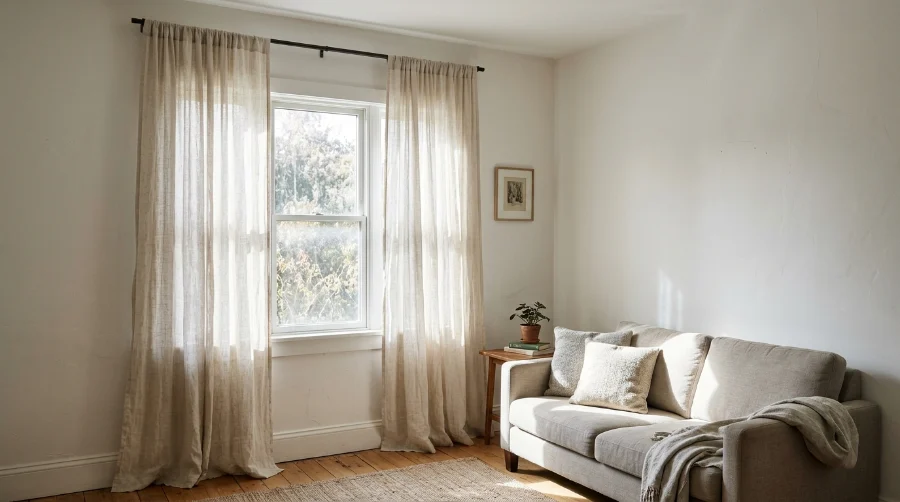
Curtains do more than cover a window. In a small room they affect how much daylight comes in, how wide the window appears and how much visual space the wall seems to have. Choosing them well is mostly a matter of proportion and fabric, not of finding a dramatic pattern.
One of the simplest ways to make a window look taller is to fit the rod above it. A common approach is to place the rod about 4–6 inches (10–15 cm) above the top of the window frame, or closer to the ceiling if there is little space. The eye reads the curtain track as the top of the window, so the window appears to extend upward.
Check what is above the window before deciding. A cornice, a sloping ceiling or a light fitting may limit how high the rod can go. If drilling is not allowed, a tension rod inside the recess still works, although it will not create the same effect.
Leave roughly 6–12 inches (15–30 cm) of wall at each side of the window. Curtains can then sit clear of the glass when they are open, letting in more light and making the window look wider. A rod that stops at the frame traps the fabric against the wall and narrows the room visually.
Measure the full width you want before buying a rod. It needs to be long enough for the brackets and the finials as well as the fabric. In a very small room, a longer rod with lightweight curtains often works better than a short rod with heavy ones.
Curtains that end just above the floor look neat and avoid the fabric gathering dust. A length that stops midway down the wall usually makes the room feel awkward, because it cuts the wall into two parts. If a radiator sits under the window, check that the curtain clears it rather than trapping heat behind the fabric.
For a room where children or pets move around, a slightly shorter length may be more practical. Long fabric that drags on the floor wears quickly and can be a trip hazard. Measure from the rod, not from the window frame, because the rod is where the curtain starts.
Heavy fabrics block light well and can make a room feel cosy, but they also take up visual space. In a small room, medium-weight linen-look or cotton fabrics usually feel lighter. They hang well without the solid block that thick velvet creates.
Sheer fabrics let daylight through while softening the view. They work well on their own in a room used during the day, or behind a heavier curtain where privacy is needed at night. Two layers require a rod that can carry the extra weight, so check the fixing before adding them.
A fabric that blends with the wall makes the window area feel larger. A strong contrast draws attention to the window and can break the room into smaller pieces. That does not mean small rooms must be plain; a narrow stripe or a quiet texture can add interest without fighting the space.
If the room already has a busy rug or artwork, plain curtains often give the eye a place to rest. Choose the fabric after the larger furnishings are in place, so it responds to the room rather than competing with it.
Rings, tracks and brackets should glide easily. If curtains are difficult to pull, people will leave them half closed. In a small room, that can make the space feel darker than it needs to be. Test the movement before committing to a system, especially with heavier fabric.
For renters, tension rods and command-style brackets offer a reasonable temporary solution. They suit light curtains better than heavy ones. Whatever the fixing, make sure it is secure; a falling rod is more than an inconvenience.
A room may need full privacy in the evening and open daylight during the day. Two layers handle that better than one heavy curtain that is either fully open or fully closed. A sheer layer stays in place while the heavier layer moves, which also reduces wear on the main fabric.
When curtains close, the edges should overlap slightly so no gap is left in the middle. Measure the finished width and remember that gathered fabric takes up more rod space than flat fabric. If the panels barely meet, a narrow gap will remain at the center every night.
In a ground-floor room or one facing a busy street, consider how the fabric looks from outside when the room is lit. Lightweight sheer fabric may offer little privacy after dark. A lined curtain or a second layer solves that without permanently blocking the view.
Most of these are measurement problems rather than taste problems. A few minutes with a tape measure saves a return trip and a disappointing result.
Hold a fabric sample against the wall in daylight and again in the evening. Notice whether it makes the window feel larger or smaller. Check how it falls at the edges and whether it blocks the light you want to keep.
Good curtains in a small room do not need to be expensive or elaborate. They need to hang higher and wider than the window, use a fabric that suits the light, and move easily. When those three things are right, the room feels calmer and more open. Measure twice before ordering fabric, especially if it is made to order and cannot be returned.
Guides that pair well with this one.
Choosing paint for a small room is less about following a rule and more about understanding the light in that particular space. A pale color in a dark room can…
A mirror is one of the few decorating choices that can change how large a room feels without moving a single piece of furniture. It works by reflecting light and by…
A single window covering is often asked to do too much in a small room. A blind alone controls light but can look hard against a bare window; curtains alone soften…