Home Decorating
Curtain Details That Change a Small Room
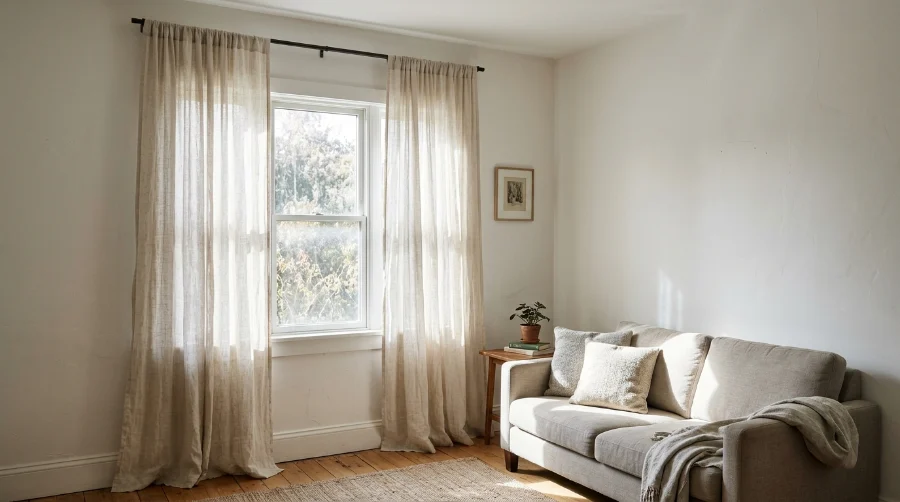
Curtains do more than cover a window. In a small room they affect how much daylight comes in, how wide the window appears and how much visual space the wall seems…
A single window covering is often asked to do too much in a small room. A blind alone controls light but can look hard against a bare window; curtains alone soften…

A single window covering is often asked to do too much in a small room. A blind alone controls light but can look hard against a bare window; curtains alone soften the light but rarely stop an early sun or give precise privacy after dark. Layering the two separates those jobs. One layer deals with the amount of light, the other with the feel of the room, and together they offer more flexibility than either covering by itself. The arrangement works best when the pair is chosen for the problem it solves and fitted with the room's limits in mind.
The layer closest to the glass is the working one. A roller, cellular or venetian blind can be raised, lowered or angled to cut glare, soften a hard beam of sun and block the view from outside at a chosen point. Because it sits within or just over the window recess, it takes up almost no visual space in a small room. It is the layer that does the precise, everyday adjusting.
The curtain or drape on the room side does a different job. It softens the edges of the light, reduces draughts from a single-glazed window, adds a little insulation and gives the window a finished frame. When it is pulled open, a generous curtain also hides the blind's brackets and headrail. In a compact room that matters: the window looks dressed without a second structure competing for attention.
Layering is most useful where one covering cannot meet conflicting needs. A bedroom facing the rising sun is the clearest case. A blind can be lowered against the early light while a lined curtain stays drawn for darkness, then both can be opened fully in the afternoon. A street-facing small room has the same pattern in reverse: a sheer curtain keeps the daylight and the view by day, while a closed blind and a heavier curtain restore privacy at night.
Glare on a screen is another practical reason. A blind angled to throw light away from a monitor or television solves the problem directly, and the curtain prevents a bright window from sitting beside a dark screen as a harsh contrast point. Rooms with draughty windows benefit too, because the curtain holds still air against the glass while the blind handles the sun. The question to ask is whether the room has two different light problems at different times. If it does, two layers have a purpose.
Think of the window covering as a combination rather than two separate purchases. A simple roller or cellular blind paired with a curtain is the most common and most forgiving arrangement. A venetian blind works well where light needs to be angled rather than simply blocked, and it sits neatly behind a heavier drape. Where a full blackout is needed, a blackout blind can sit behind a lighter curtain, which keeps the room soft by day and dark at night.
Check how each layer is operated before committing. If the blind cord and the curtain hang in the same place, one will tangle with the other. Cordless and wand-controlled blinds are easier to live with behind curtains, and any loose cords should be kept short and out of reach of children and pets. Allow for the stack as well: when a curtain is fully open, its fabric gathers at either side of the window. In a small room the window may sit close to a corner or a radiator, so confirm that the stacked fabric has somewhere to rest.
Fit the working layer first. A blind mounted inside the recess keeps the window tidy and leaves the wall above free for the curtain track. If the recess is too shallow, an outside mount still works, provided the brackets do not sit where the curtain will hang. Once the blind is in place, fix the track or rod above and wider than the window, then hang the curtain last and test both layers together.
Leave a gap of roughly 2 to 4 inches (5–10 cm) between the blind and the curtain so the blind can be raised and lowered without catching. The curtain track should extend about 6 to 12 inches (15–30 cm) beyond the window on each side, which lets the fabric clear the glass when open. Where the window is close to the ceiling, a track mounted just above the reveal saves wall space and looks intentional. Measure the depth of both layers before buying brackets; a deep blind headrail plus a chunky curtain rod can project further than expected into a small room.
Two layers close together are seen as a single feature, so they need to agree. Related tones are the safest route: a blind in a light neutral with a curtain a shade deeper, or a curtain that picks up one quiet color from the blind. Pattern is best kept to one layer only. Two competing designs make a small window look busy and can shrink the room visually.
Hardware should match as well. Brackets, rods and finials in the same finish read as one installation, while mixed metals draw the eye to the joins. Where the room already has a strong color scheme, continuing it through the curtain rather than introducing a new accent keeps the window calm. The goal is for the layers to look like a deliberate system, not two solutions bought at different times.
Blinds collect dust faster than curtains because they sit close to the glass and often near a heat source. A soft brush or the low setting of a vacuum attachment deals with most of it; wooden slats should be kept dry, and fabric shades need only light spot cleaning unless the care label says otherwise. Curtains need less frequent attention but should be vacuumed along the folds and laundered or cleaned according to the fabric. The top hem is often forgotten.
Choose a curtain that can be taken down without disturbing the blind, and clean both layers in the same session so neither is neglected. Fabrics that can be washed at home are easier to maintain in a small household than ones that always need specialist cleaning. If the curtain hangs against the blind, check occasionally that the lower edge is not rubbing and trapping grit.
Layering is a tool, not a rule. A small north-facing window with no strong sun and no privacy issue may be perfectly served by one good cellular shade. A bathroom with frosted glass rarely needs a second layer, and a rarely used room can manage with a single blind that already offers a blackout option. In a very tight space, the fabric stack of a second layer may take more room than the light control it provides.
Where a single covering meets the room's needs, adding another is decoration rather than function. Start with the actual problem: early light, night privacy, glare on a screen or a draught. If one layer solves it, stop there. If two different problems show up at different hours, a paired blind and curtain is one of the simplest ways to give a small room better control without changing anything else.
Guides that pair well with this one.
Curtains do more than cover a window. In a small room they affect how much daylight comes in, how wide the window appears and how much visual space the wall seems…
The most common problem with rugs in small rooms is not color or pattern. It is size. A rug that is too small makes a room feel broken into islands, while one that…
A gallery wall looks relaxed in photographs, which is why people often start hanging frames without a plan. The result is usually a group that is slightly crooked…