Home Decorating
Decorating a Small Home With the Right Plants
Plants bring color, texture and a sense of life into a small home, and they cost far less floor space than most decorative furniture. They also have a reputation…
A handful of hooks on a wall is a tidy idea that can turn into a busy one. Each item added seems harmless on its own, but coats, hats, bags and tools gradually…
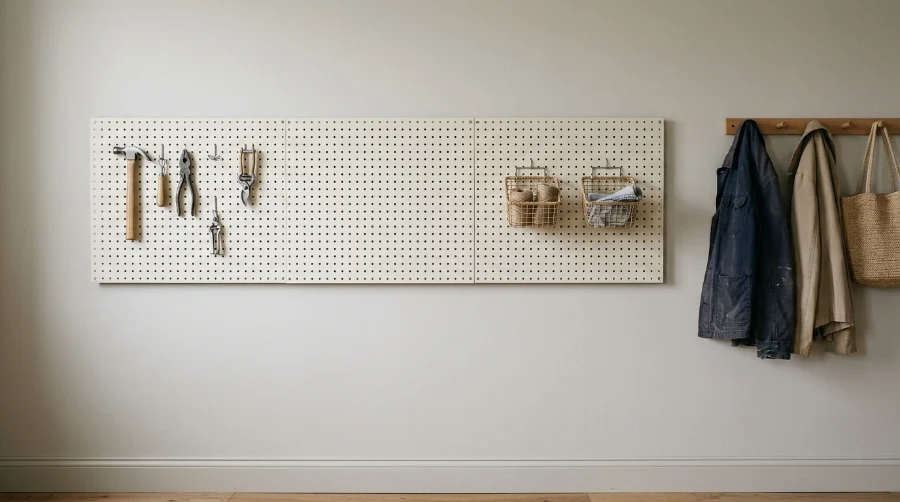
A handful of hooks on a wall is a tidy idea that can turn into a busy one. Each item added seems harmless on its own, but coats, hats, bags and tools gradually spread until the wall reads as a jumble rather than as storage. The difference between an organized wall and a messy one is rarely the number of hooks. It is whether the wall has clear zones, consistent containers and some empty space left there on purpose.
Before fixing anything, decide what each area of the wall is for. A hall wall might have one zone for outdoor clothing, one for bags and one for a small ledge. A utility wall might divide into cleaning, gardening and tools. Keeping each activity in its own stretch stops items migrating across the whole surface and makes it obvious where a thing belongs when it is returned.
On a pegboard, draw the zones in pencil first and leave a band of empty holes between them. That gap is not wasted space; it is what allows the eye to read one group as separate from the next. As a general guide, aim to cover around 60 to 70 percent of the board and resist filling the rest. A wall that is completely covered always looks crowded, even when every item is neatly hung. If a new object needs a home and every zone is full, something should leave or move into a container rather than a new hook being added.
Mixed hook styles are a common source of visual noise. A row of matching hooks in one finish reads as a single fitting, while six different shapes read as six separate objects. The same principle applies to storage on the board: a set of identical baskets or small bins looks orderly, whereas a collection of assorted boxes looks like a tip. Choosing containers that slip onto the pegboard system makes them easy to move as the zones change.
Containers are also what keep small items from dangling in every available gap. Screwdrivers, cables, keys, cloths and craft bits are awkward to hang individually and much calmer grouped in a bin. Use the hooks for things that have a clear shape and are reached often, and the containers for everything small. If labels are needed, keep them uniform and discreet; a wall of different-sized handwriting is its own kind of clutter.
A wall of hooks works best when some of what hangs there is worth looking at. Items with a clean silhouette, such as a woven bag, a few wooden-handled tools, a hat or a coat in good condition, can be left in plain view. They give the wall a purpose and a pattern. Things that are visually busy, greasy, worn or rarely used should live in a closed box or basket on the board rather than on an exposed hook.
A simple test helps: if the item has a shape worth seeing, hang it; if it does not, box it. This is not about hiding everything, but about deciding which objects contribute to the wall and which merely occupy it. In a small room, where every wall is close to the seating or the bed, that distinction matters more than it does in a large garage. An exposed wall should look intentional from across the room, not just when standing in front of it.
Height affects both appearance and use. Items reached daily are best hung between roughly 48 and 60 inches (120–150 cm) from the floor, around eye to shoulder level, so they can be taken and replaced without reaching up or bending. Occasional things can go higher, and hooks for children should sit near 36 inches (90 cm) or lower so they are genuinely independent. A pegboard above a worktop should start high enough that the surface below stays usable.
Check what is at the mounting height before drilling. A hook rail that looks fine on an empty wall may collide with a door, a lampshade or the back of a chair once the room is in use. Leave enough space for the item to hang without brushing the furniture beneath it. A coat that swings against a console all day will push hooks loose and look untidy no matter how careful the arrangement was to begin with.
The fixings must suit the wall, not just the hook. Light objects can hang on fine hooks into plasterboard, but a loaded pegboard or a row of heavy coats needs stronger support. Where possible, fix into studs or masonry, and use anchors rated for the weight being hung. A pegboard that holds tools should be mounted with spacers and several fixings across its width; one screw at each corner is rarely enough once the board is full.
Spread heavier items across the board instead of clustering them on one hook, and give the whole fitting a firm tug before trusting it. Where drilling is not an option, adhesive hooks have their place, but they are suited to light loads and should be treated as temporary rather than permanent. In rented homes, accepting a lower weight limit is safer than damaging the wall. Anything valuable or genuinely heavy is better stored on a shelf than hanging from an unknown fixing.
The most useful habit is simple: nothing goes on the wall without a zone, and every zone keeps some empty space. When a new item appears, it must either join its group in a container or replace something that leaves. This prevents the slow drift from a tidy rail into a wall of hanging objects, because the empty gaps are treated as part of the arrangement rather than as space waiting to be used.
Once a week, step back and view the wall from the doorway. If it reads as a single calm system, leave it alone. If it looks busy, remove the most recent additions first and return them to drawers or boxes. That quick visual check catches clutter far earlier than a full clear-out, and it keeps hooks and pegboards doing what they do best: giving frequently used things a visible home without taking over the room.
Guides that pair well with this one.
Plants bring color, texture and a sense of life into a small home, and they cost far less floor space than most decorative furniture. They also have a reputation…
Curtains do more than cover a window. In a small room they affect how much daylight comes in, how wide the window appears and how much visual space the wall seems…
A neutral room can feel calm without feeling flat. Texture is what keeps it interesting: the weave of a cushion, the grain of a wooden table, the pile of a rug…