Bathroom Ideas
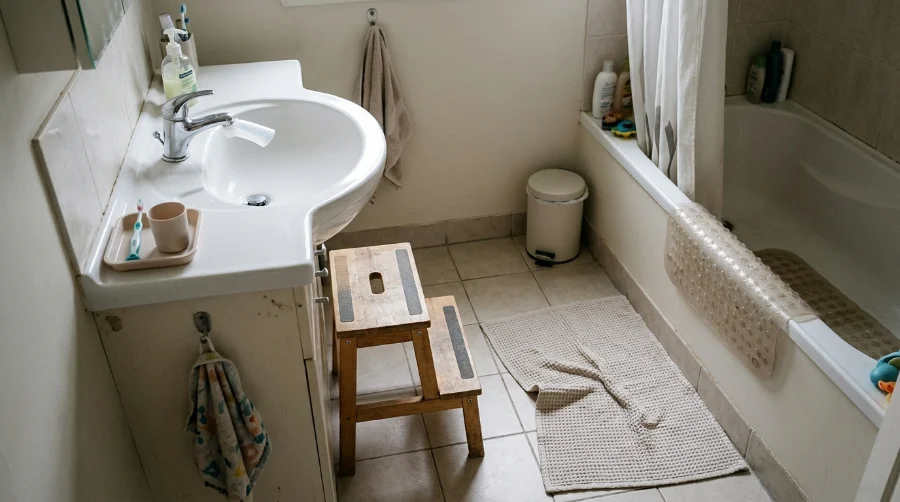
A Bathroom Set Up at a Child's Height
A bathroom designed for adults assumes a user who can reach the tap, judge hot water, and step over the bath edge. Children can do none of these reliably. Setting…
Deep bathroom drawers have a particular way of hiding things. Small tubes roll to the back, cotton pads settle behind a row of bottles, and the items used every…
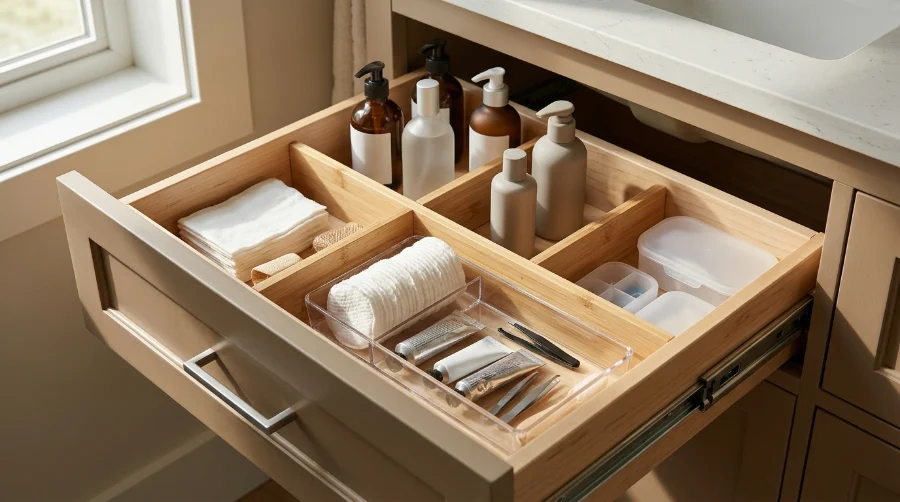
Deep bathroom drawers have a particular way of hiding things. Small tubes roll to the back, cotton pads settle behind a row of bottles, and the items used every morning end up buried under things that were put there months ago. A vanity can look tidy with the drawer shut and still be almost impossible to use. The fix is not more care at tidying time but a layout that keeps everything visible, reachable and easy to put back.
Begin with the whole drawer out on a flat surface. Sorting through items where they sit tends to shuffle them from one pile to another without reducing anything. Group what is there into daily use, occasional use, and things that no longer belong in a bathroom at all.
Be honest about duplicates. Half-used tubes, spare travel toiletries and three tubes of the same cream are common in shared drawers. Keep one of each category in the active space and move the remainder to a lidded box elsewhere, or discard anything past its usable life.
The goal is not a smaller collection for its own sake but a drawer where a person can see what is available. A half-empty drawer is easier to maintain than a full one, because every item has a place to return to.
Set a holding box aside before you begin. Anything removed from the active drawer but not yet ready to discard needs a temporary home, and putting it straight back on the vanity defeats the purpose. Label the box with a month and review it later; most items are easier to let go the second time around.
Dividers turn one deep cavity into several small zones. Adjustable sections are useful because the mix of items changes over time; fixed compartments can leave awkward gaps once a product runs out. Aim for sections that are just wider than the objects they hold, so nothing tips sideways when the drawer closes.
Measure the inside of the drawer before buying any insert, including the depth at the back where the runner mechanism intrudes. An organiser a centimetre too wide will jam, while one that is too shallow leaves a hidden strip where items still collect.
Trays are the simplest option. A shallow tray keeps small things together and can be lifted out for cleaning. Two or three trays in one drawer often work better than a single large insert, since each can be assigned a category and slid aside.
Tiered or stacked organisers solve the depth problem by raising the back row above the front. This makes the contents of a deep drawer visible at a glance instead of requiring a search. Choose tiers with a slight lip so items do not slide off when the drawer is opened quickly.
Containers that can be wiped clean matter in a damp room. Smooth plastic, coated wire or sealed bamboo handles moisture better than untreated cardboard, which softens and absorbs spills. If fabric bins are used, remove them regularly to air out. A container that stays damp inside will smell long before the drawer looks untidy.
Frequency should decide position. The objects used every day belong at the front of the drawer, where a hand can reach them without moving anything else. Occasional items — hair treatments, spare razors, special occasion products — sit behind or above them.
This principle matters more in a shared bathroom than in a private one, where the same person always knows where everything is. When several people open the same drawer, a predictable front-to-back order prevents a daily search.
Keep the very front row shallow. Tall bottles at the front obscure what sits behind them, so reserve the back for anything upright and the front for flat items such as cotton pads, floss and small tubes.
Think about where a person stands when using the drawer. Items needed by the dominant hand should fall within easy reach from that position, while heavier objects belong near the center so the drawer stays balanced on its runners.
Standing bottles upright uses height rather than floor area and keeps labels readable. It suits tall products such as shampoo, mouthwash and lotion, provided the drawer is deep enough from front to back. Use a divider at the rear so tall items do not tip when the drawer is closed.
Stacking suits flat items — cotton rounds, wipes packets, grooming tools — but a stack only works if it is shallow. A pile more than a few layers high collapses into the drawer the first time someone reaches for the bottom item. Store stacks inside a tray so they move as a unit.
Mixing the two in one drawer is common and workable: tall bottles at the back in their own section, a low tray of stacked items at the front. The mistake is placing tall and flat items in the same zone, where one constantly hides the other.
A shared vanity needs clear boundaries. Without them, one person's products migrate across the drawer until nobody can find anything. Give each regular user a defined section rather than mixing everything by product type.
Assign a tray or a set of compartments to each person, ideally in the same position every day. Color-coded trays make the boundary obvious without relying on labels that people ignore. If the drawer is too small for separate sections, use a second drawer or a lidded box kept on a shelf.
Keep shared items — soap, toilet paper, cleaning wipes — in a neutral zone that belongs to nobody in particular. This prevents the quiet accumulation of personal products in the communal space and makes it obvious when a shared item needs replacing.
Drawers collect products long after they are useful. Set a habit of checking once or twice a year and removing anything that has changed in smell, texture or color, or that has been open far longer than is reasonable. Sunscreens, medicated creams and anything with a printed date deserve particular attention.
Editing is easier when items are visible, which is another reason to avoid deep piles. A drawer that is checked regularly stays small; one that is ignored for years becomes a store of half-forgotten bottles that nobody dares to sort.
Vanity storage also has a limit that no organiser can remove. If the drawer must hold makeup, grooming tools, medicines, first-aid supplies and cleaning items at once, it will stay crowded. Move category by category to other places — a wall cabinet for medicines, a shelf for spare toiletries — until the drawer holds only what is used at that spot. A well-organized drawer is one that has been allowed to hold less.
The measure of a working vanity is simple: open the drawer, find what is needed, and close it again without rearranging anything. Dividers and trays help, but the real work is deciding what belongs there in the first place and giving each item a fixed home.
Guides that pair well with this one.
A bathroom designed for adults assumes a user who can reach the tap, judge hot water, and step over the bath edge. Children can do none of these reliably. Setting…
Towels are bulky, and a small bathroom rarely has a good place for them. Left on a hook behind the door, they stay damp and never quite dry. Piled on a shelf, they…
Few rooms have less give than a small bathroom. The door, the toilet and the shower all need clear space, and there is usually no spare corner for a cabinet. Good…