Kitchen Organization
Keeping a Galley Kitchen Clear From End to End
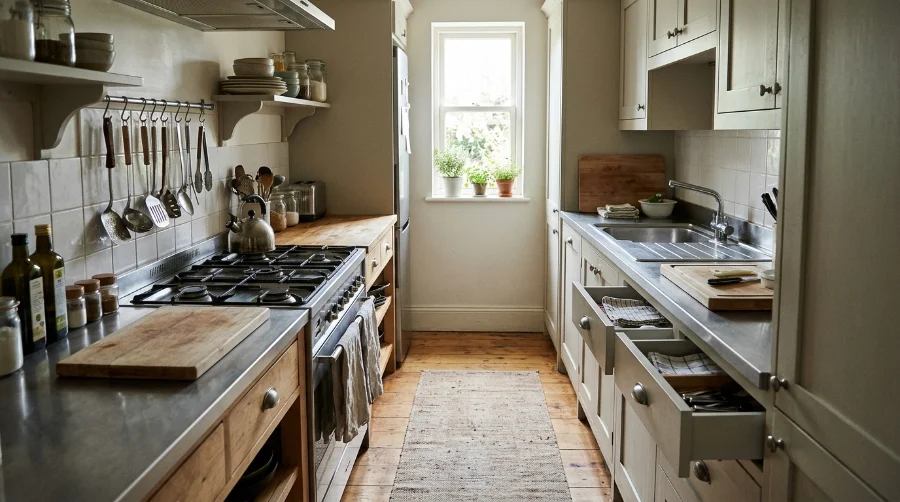
A galley kitchen is a corridor with work surfaces on both sides. It is efficient by design, because everything is within a few steps, but it is unforgiving of…
Baking equipment has a recognisable pattern. It arrives in bursts, most of it is used only occasionally, and the pieces are awkwardly shaped: flat trays, round…
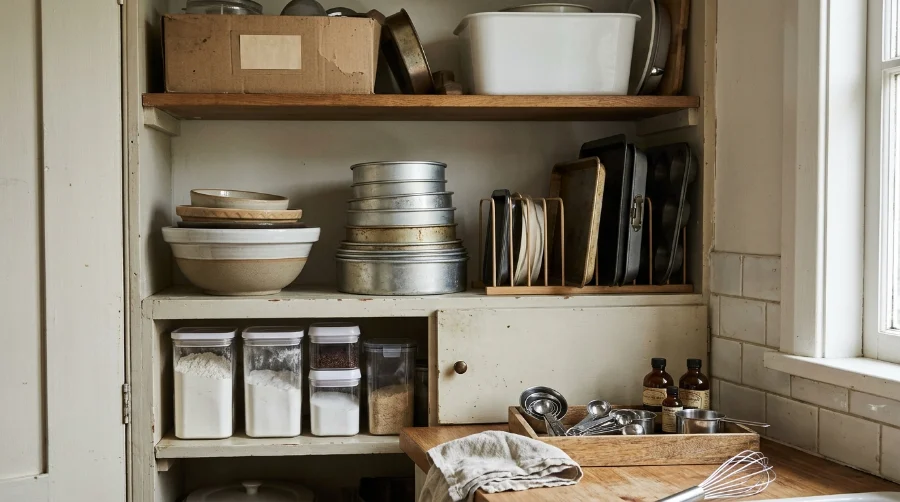
Baking equipment has a recognisable pattern. It arrives in bursts, most of it is used only occasionally, and the pieces are awkwardly shaped: flat trays, round tins, nested bowls, and bags of flour that refuse to stand upright. Before long a cake tin is propped against the toaster and a bag of icing sugar lives on the floor. Organizing baking supplies in a small kitchen is less about finding clever containers and more about accepting that these items follow their own logic, and giving them a home that matches how a bake actually happens.
Instead of sorting by material or by where things were bought, arrange supplies around the four stages of a bake: measuring, mixing, shaping, and storing. Measuring tools include scales, cups, and spoons; mixing covers bowls, whisks, and beaters; shaping holds tins, cutters, and piping bags; storing is for the finished result. This grouping mirrors the order of work, so everything needed at one stage sits together and can be reached without hunting through another pile.
Keep each group in its own container or zone, even if that zone is only a section of a shelf. A shallow tray for measuring tools can be pulled out and set beside the worktop, then slid back afterwards. Bowls can nest inside one another on a high shelf, while tins stand upright in a divided rack. Broad groups are easier to maintain than fine ones: four well-defined areas beat twelve tiny categories that no one can remember.
Everyday measuring tools deserve the most accessible spot, because they are used at the start of almost every recipe. Mixing bowls can go slightly higher or deeper since they are lifted down once and returned at the end. Tins and cutters are bulky but rarely needed, so they suit the back of a cupboard, a high shelf reached with a step stool, or the space below a wall cupboard. Finished-goods storage such as cake boxes can be flattened and tucked behind other items until a bake is under way.
Flat objects waste extraordinary amounts of space when laid on top of one another. Baking trays, cooling racks, and large cutters should stand on their edge in a divider or against the side of a cupboard, where each one can be taken singly. A lid organiser or a simple set of vertical separators keeps them from sliding into a leaning heap. When space is tight, store them behind a row of tins rather than on a shelf of their own.
Round and tapered items behave differently. Mixing bowls nest neatly, but a small bowl placed inside a large one can become stuck, so leave a little gap or place a cloth between them. Cake tins stack well if their rims are similar in size; mismatched tins wobble and topple. Keep lids with their containers and store them upright beside the base rather than balanced on top, since a lid that is always buried will eventually be left off. The small effort of stacking carefully pays back every time a tin is pulled out intact.
Dry ingredients are heavy and used in quantity, so they should live low and close to where mixing happens. A lower cupboard shelf, the space below a worktop, or a pull-out basket is better than a high shelf that requires lifting a full bag overhead. Keep flour, sugar, and oats together, with the items used most often at the front. If the original bags are stiff and awkward, decant them into square containers that sit flat and stack; a square tin wastes far less shelf depth than a round one.
Smaller ingredients such as bicarbonate of soda, baking powder, vanilla, and food colouring belong in a shallow tray where every bottle can be seen. Group them with the dry goods rather than with the general spices, because following a recipe should not mean searching two areas. A label on the container front is enough; individual labels on every small packet add work without helping. When a container is empty, refill it from the store cupboard rather than moving the whole supply into the baking zone.
Flour, sugar, and nuts are vulnerable to damp and to insects, and a small kitchen often has both problems close to the cooker. Choose containers with tight-fitting lids and check that the seal still closes after repeated use. A gap of a few millimetres is enough for moisture to enter and for a pantry moth to get in. Keep dry goods away from the kettle, the hob, and the sink splash zone; a cool, dark cupboard is more useful than a pretty jar on a sunny windowsill.
Look at stored ingredients when the baking box is opened. Clumps, a musty smell, or small webs mean the contents should be discarded and the container washed and dried fully before it is refilled. Whole nuts and chocolate keep better in a sealed container in a cool spot, since warmth turns them soft or greasy. Buy quantities that will be used within a reasonable period rather than the largest pack on offer; a small household that bakes once a month does not need a huge sack of flour occupying valuable space for half a year.
Most bakes rely on a surprisingly short list of tools. A scale, a couple of bowls, a whisk, a spatula, a measuring spoon set, and one or two tins cover a large share of ordinary recipes. Keep that core accessible and send everything else to storage. A pastry brush used twice a year, a set of shaped cutters, a piping kit, or a bread tin that only appears at holidays can live in a labelled box on a high shelf or under the worktop.
Label the box broadly, such as "occasional baking", and list the larger items on the side so they can be found without unpacking it. If a piece of equipment has not been used in a year and no specific plan exists for it, consider passing it on. Specialty gear is easy to accumulate because each item seems small at the time of purchase; together, those items can fill a cupboard that the household would rather use for food.
Organization cannot create worktop space. In a small kitchen, a full bake may still require clearing a counter, washing bowls mid-recipe, or working in stages. Planning for that reality is more useful than buying another rack. Choose recipes that suit the equipment on hand, and borrow a tin or a large bowl for the occasional ambitious project rather than storing it permanently against the day it might be needed.
Accept also that some items will always be slightly awkward. A large baking sheet may have to lean behind the cupboard door, and a stand mixer may never find a home off the counter. The aim is not a perfect system that hides every object, but a kitchen where the tools for an ordinary bake can be gathered in a couple of minutes and put away again without a struggle. When the core set works smoothly, the rare complicated recipe is a reasonable exception rather than the reason the whole kitchen is arranged.
Guides that pair well with this one.
A galley kitchen is a corridor with work surfaces on both sides. It is efficient by design, because everything is within a few steps, but it is unforgiving of…
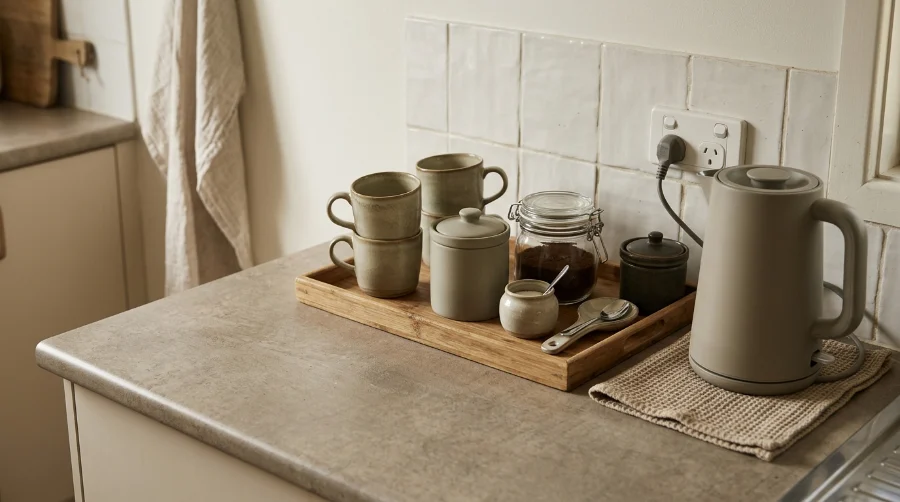
Making a hot drink is a small sequence repeated many times a day: reach for a cup, add coffee or tea, boil water, sweeten, stir, and clean up. When those six steps…
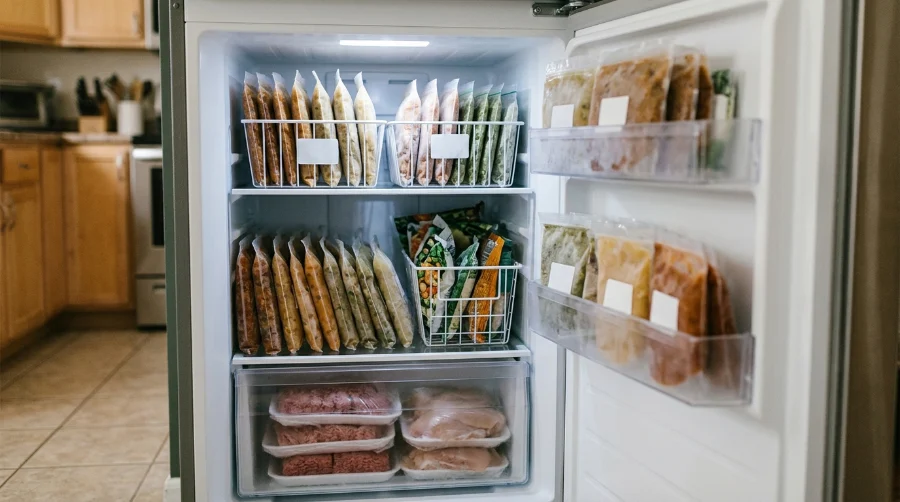
A freezer is easy to forget until something is lost at the back of it. Unlike a fridge, it hides food in solid blocks and frost, and a bag of vegetables can be…