Everyday Home Tips
Five Weekly Checks That Prevent Costly Home Repairs
Small home problems become expensive when nobody looks at them for months. A weekly maintenance routine is not a deep cleaning session. It is a short, repeatable…
Most household repairs are small. A cupboard door that has worked loose, a picture that needs a proper anchor, a gap around a worktop or a squeaky hinge rarely…
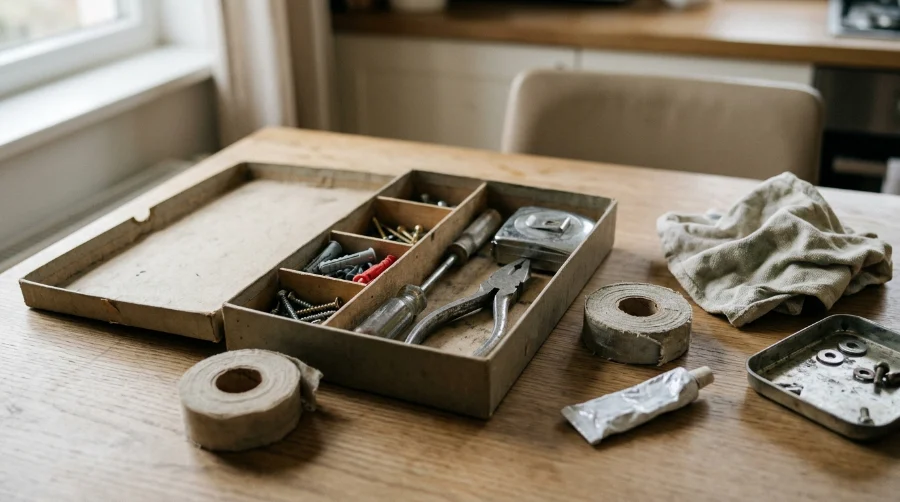
Most household repairs are small. A cupboard door that has worked loose, a picture that needs a proper anchor, a gap around a worktop or a squeaky hinge rarely calls for a professional. What they call for is a modest collection of consumables and a few basic tools kept together, so the fix can be made the same day instead of being put off until a trip to the shop. A minimal kit is not a cut-down workshop. It is a deliberate choice of the things most likely to be needed quickly, stored in one place and easy to carry to the job.
Start with the problems rather than the tools. Think through the minor faults a household actually meets: a screw that will not hold, a small hole in a wall, a loose floorboard, a peeling seal, a drawer that sticks, a tap that drips slowly. For each one, note what would be needed to stop it getting worse. That list is the kit. It is a far better guide than a ready-made set chosen for the number of pieces it contains.
Keep the first version small. Add an item when a real repair calls for it and the gap becomes obvious, rather than buying everything at once. A kit that holds thirty things a household never uses is harder to search than one that holds twelve it does. The aim is to shorten the distance between noticing a problem and dealing with it, not to prepare for every possible fault in the building.
Loose fixings cause more minor damage than almost anything else. Include a small assortment of general screws in two or three common lengths, a few small nails, washers, and short cable ties. Washers are easy to overlook but useful when a screw has pulled through a thin panel. Cable ties can hold a loose cable or bundle temporarily until a proper fix is possible.
Wall fixings deserve a section of their own. A few plastic plugs for masonry and a few self-drilling anchors for plasterboard cover the two surfaces found in most homes. Match the anchor to the wall: a plug that grips brick will not hold in a hollow wall, and a plasterboard fitting meant for a light frame is wrong for a heavy shelf. A small packet of picture hooks handles hanging jobs without drilling a new hole each time. Sort these into a divided compartment by type, because hunting through a mixed bag is what makes a kit feel disorganized.
Filling and sealing materials deal with the small gaps that let in draughts or water. A small tube of multi-purpose filler repairs a wall chip or a nail hole, and a sheet of fine sandpaper smooths it once set. A tube of general sealant is useful around a sink, bath or worktop where an old bead has lifted. Choose a type suited to the surface and follow the drying guidance on the packaging; a sealant applied to a damp or greasy edge will peel again quickly.
Tapes and adhesives cover a different set of jobs. Masking tape protects surrounding surfaces while filling or painting. A roll of cloth tape holds things firmly for a short-term fix, and a general-purpose glue handles a loose wooden joint or a small plastic part. Keep the tubes and rolls together and check them occasionally, since adhesives thicken and sealants can form a skin if a cap is left loose. A small plastic scraper and a clean cloth finish this group; applying filler neatly is much easier when the excess can be removed before it hardens.
The tool selection should stay deliberately short. A screwdriver with interchangeable bits, or a small set covering the two common head types, handles most loose fixings. Add a pair of general pliers, a small adjustable spanner, a utility knife with a covered blade and a tape measure. A compact spirit level is worth the space when a shelf or frame needs to sit straight, and it doubles as a straightedge. That is enough for the repairs this kit is meant for.
Resist adding a drill, a saw or a hammer at the first round. Each brings weight, storage problems and safety considerations, and each is usually needed only after a job has grown beyond minor. When a repair genuinely needs one of them, borrow it, hire it or buy it as a separate decision. Keeping the kit light means it can be lifted out of a cupboard and carried to the room where the problem is, instead of staying put because it is too awkward to move.
Repairs are messy even when small. Keep a few clean rags and one absorbent cloth in the kit, along with a flat tray or a piece of card to work on. Wiping a surface before applying sealant and cleaning up afterwards often decides whether the fix lasts. A dust sheet is unnecessary at this scale, but having something to catch offcuts matters on a carpet or a worktop.
Store everything in one shallow, lidded box with divisions, kept in an accessible cupboard rather than high on a shelf. A container that can be carried in one hand encourages use; one buried behind cleaning products does not. Group the sections by the categories above so the contents are visible at a glance, and keep the box away from heat and damp, which spoil adhesives and tapes. If children or pets are in the home, a latch on the lid is a sensible precaution, particularly once a sharp knife is included.
A small kit is for minor, familiar problems. Work involving mains electricity, gas appliances, structural changes or a significant leak belongs to a qualified person, and so does anything that has become too large to understand confidently. Before starting a repair, make sure the power or water is isolated where relevant, and stop if the fix begins to affect a pipe, a cable or a load-bearing part. Eye protection is worth wearing when drilling or breaking material, and sealants and glues need reasonable ventilation.
Review the contents every few months. Replace filler that has hardened in its tube, sealant that has skinned over, and tape that has lost its grip. Check that blades are still covered and that hooks and anchors have not been used up without being replaced. A short list inside the lid of what belongs in each section makes this quick and shows at once when something is missing.
What separates this kit from a full workshop is scope, not skill. A workshop is built for planned projects and large repairs, with power tools and quantities of material. This kit is built for the ten-minute job that prevents a small fault from becoming an expensive one. Kept small, checked occasionally and used within clear safety limits, it handles the ordinary fixes that come up in every home.
Guides that pair well with this one.
Small home problems become expensive when nobody looks at them for months. A weekly maintenance routine is not a deep cleaning session. It is a short, repeatable…
Leaving a home for a week is easier when the preparations are ordinary and repeatable. A short checklist removes the need to remember everything on the day of…
Most cleaning plans fail for the same reason: they ask for more than a normal week can deliver. A long list of daily chores looks impressive on paper, but it…