Everyday Home Tips
Five Weekly Checks That Prevent Costly Home Repairs
Small home problems become expensive when nobody looks at them for months. A weekly maintenance routine is not a deep cleaning session. It is a short, repeatable…
Most cleaning plans fail for the same reason: they ask for more than a normal week can deliver. A long list of daily chores looks impressive on paper, but it…
Most cleaning plans fail for the same reason: they ask for more than a normal week can deliver. A long list of daily chores looks impressive on paper, but it collapses after a few busy days and leaves a household feeling behind. A schedule that survives real life is built around frequency and rooms, so the work is spread out and each task has a sensible moment.
Not everything in a home needs the same attention. Daily tasks are those that affect comfort and hygiene directly: wiping the kitchen surface, dealing with dishes and clearing a bathroom used by several people. Weekly tasks include vacuuming, changing bed linen and cleaning floors. Monthly or seasonal tasks cover the things that accumulate slowly, such as inside cupboards, skirting boards and appliance filters.
Sorting by frequency stops the common mistake of treating every surface as urgent. When everything is on today's list, nothing gets done properly. When the list reflects how quickly an area becomes dirty, the routine feels achievable.
A room-by-room approach works because it limits the scope of each session. The kitchen list might cover the hob, the worktop, the sink and the floor. The bathroom list might cover the basin, the toilet, the shower and the mirror. Keeping the tasks within one room avoids the constant back-and-forth that makes cleaning feel longer than it is.
Write the list for each room and keep it brief. Four or five items is enough for a weekly session. A list that runs to twenty items is a sign that the work should be split across more days rather than squeezed into one.
Assign one main room to each weekday and leave one day lighter. For example, kitchen on Monday, bathrooms on Tuesday, bedrooms on Wednesday, living areas on Thursday, and floors or neglected corners on Friday. The weekend can then absorb anything missed rather than becoming a catch-up marathon.
The specific days matter less than the pattern. Choose an arrangement that fits the household's routine, such as doing bedrooms on the day linen is changed. A plan that follows existing habits needs less willpower to maintain.
A twenty-minute block is enough to clean one room reasonably well when the list is focused. Set a timer and work steadily without trying to perfect every surface. Stopping at the end of the block creates a sense of progress and leaves the rest of the day intact.
Short blocks also make it easier to start. A task framed as a full morning of cleaning is easy to postpone; the same task framed as fifteen minutes in the bathroom is much less intimidating. Consistency over weeks matters more than one long session.
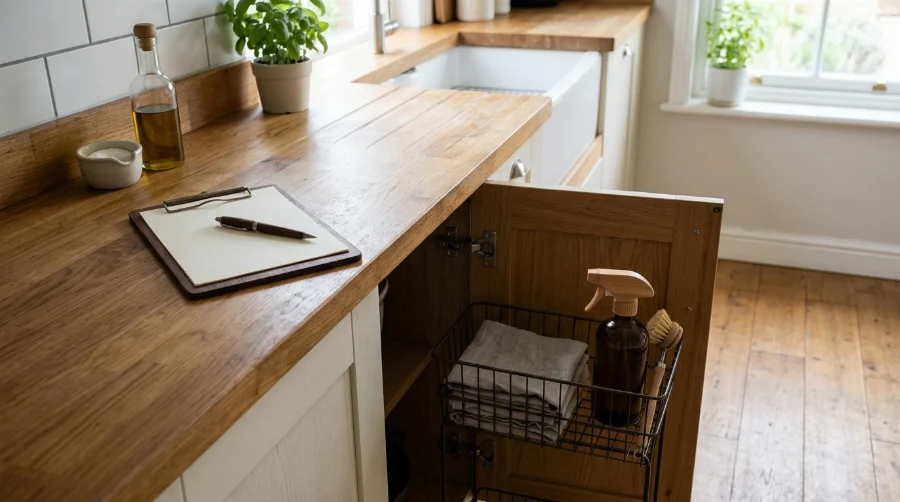
A surprising amount of cleaning time is spent collecting equipment. Keep a small caddy in or near each bathroom with a cloth, a gentle cleaner and a brush. Keep kitchen supplies under the sink in a tray that can be lifted out. When the tools are already in the room, starting is simple.
Avoid keeping multiple full bottles of everything in several places. One bottle per room, refilled from a central store, reduces clutter and cost. Label any containers clearly so nobody uses the wrong product on the wrong surface.
Within each room, clean high surfaces first and the floor last. Dust from a shelf falls onto the worktop, and crumbs from the worktop end up on the floor. Following that order means the final pass actually leaves the room clean rather than requiring a second go over.
This principle is simple but often skipped. It saves time and reduces the temptation to clean the same surface twice.
A household schedule only works if more than one person can follow it. Assign rooms or specific tasks rather than asking everyone to help in general. A clear responsibility, such as cleaning the bathroom basin each evening or handling the kitchen bins, is easier to remember and harder to avoid.
For children, give tasks that match their age and ability, such as wiping a surface, sorting laundry or clearing a table. Rotate duties occasionally so the same person is not always stuck with the least pleasant job. Keep the standard reasonable; a task done consistently by a child is more valuable than one done perfectly by an adult who resents it.
After a few weeks, look at which tasks keep slipping. A task that is regularly missed is often scheduled at the wrong frequency or placed on an unrealistic day. Move it rather than treating the miss as a failure. Equally, if a task takes far less time than expected, it can be combined with another.
Seasons change the workload. Winter brings more mud indoors, summer brings dust and pollen. A schedule that adapts to those shifts stays useful throughout the year.
One common error is buying a range of specialized products before the routine exists. A simple cloth and a gentle all-purpose cleaner handle most household surfaces. Add specific products only where a material genuinely needs them.
Another is trying to clean everything to a showroom standard every time. A working home will never look perfect, and a schedule that demands it will be abandoned. Aim for consistently clean and comfortable rather than spotless.
Cleaning needs shift through the year, and a schedule that ignores that will gradually feel out of step. Wet winter months bring more dirt indoors, so entrance floors and mats need more frequent attention. Spring brings dust and pollen that settle on surfaces quickly. Summer may mean more time outside and less time spent on indoor rooms. Reviewing the plan every few months lets these changes be absorbed without adding a permanent task that is only needed for one season.
A cleaning plan that works is modest and specific: a short list for each room, a sensible frequency for each task, supplies close at hand and a time block that fits the day. It spreads the work, shares it fairly and leaves room for real life. When the plan fits the household instead of the other way around, keeping a home clean stops being a constant battle.
Guides that pair well with this one.
Small home problems become expensive when nobody looks at them for months. A weekly maintenance routine is not a deep cleaning session. It is a short, repeatable…
Leaving a home for a week is easier when the preparations are ordinary and repeatable. A short checklist removes the need to remember everything on the day of…
Most household repairs are small. A cupboard door that has worked loose, a picture that needs a proper anchor, a gap around a worktop or a squeaky hinge rarely…