Furniture & Layout
Two Focal Points, One Leading Role
Some living rooms have two things that both want to be the center: a fireplace and a television, or a window with a view and a fireplace. Furniture cannot face two…
A television and a window often want the same wall, and the room has to decide which one wins. The window brings light and, in many homes, the only interesting…
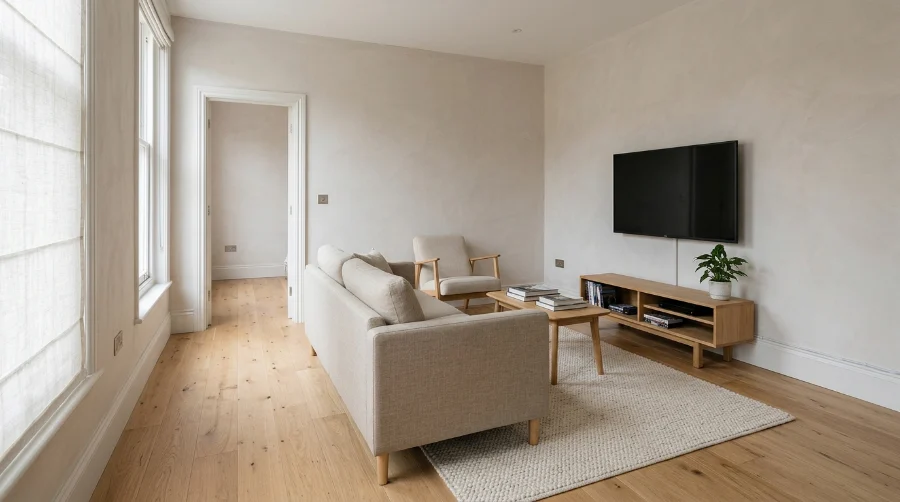
A television and a window often want the same wall, and the room has to decide which one wins. The window brings light and, in many homes, the only interesting view. The television needs a dark-enough surface and seats facing it at a sensible angle. When both are forced into the same corner, the result is glare on the screen and furniture that never quite settles. Solving the conflict means starting with the light, not with the sofa.
Spend a little time in the room at different hours of the day. Note when direct light falls on the wall where the screen might sit and when reflections appear on a glossy surface. A placement that looks fine in the evening can be unviewable on a bright afternoon.
Stand where people would sit and look toward the proposed spot. If a window sits opposite the screen, the reflection of the window will appear in the glass of the screen, and no amount of turning up the brightness fully fixes it. If the window is directly behind the television, the screen may be usable but the seats will face a bright light source, which is tiring over time.
A window to one side of the screen is usually the least troublesome arrangement. Light arrives from the side rather than bouncing straight back at the viewer, and a single blind can manage it when the sun is low.
Few small living rooms offer a perfect wall. The useful question is which compromise causes the least disruption to daily use.
This gives the best chance of a clear picture because the screen faces away from the light source. The drawback is the bright view behind the viewer, which can make the room feel less like a cinema and more like a sunroom. It works well where daylight is wanted for other activities and the television is used mainly in the evening.
Placing the screen on an adjacent wall often reduces reflection while keeping the window in the room. Check that the television does not sit right against the window frame, where light can still strike the screen at an angle. This arrangement suits rooms where the window is wide and the adjoining wall is short but usable.
This is the difficult option. If the window is narrow or high, the screen may fit beneath or beside it with limited glare. If the two must share a wall, keep a gap between them and use a blind that can cut direct sun without darkening the whole room.
A television on a swivel mount can turn away from the window for viewing and back again when not in use. It is a practical answer in rooms where no fixed position works, though the mount must be fixed into a solid wall and the swing arc kept clear of furniture.
Once the screen position is settled, arrange seats around it. Viewing distance should feel comfortable rather than forced: close enough to see detail without leaning forward, far enough that the screen does not fill the whole field of view. In a small room, this usually means keeping the main sofa opposite the screen and adding one movable chair rather than trying to fit a second sofa.
Angle seats slightly inward toward the center of the screen rather than lining them up rigidly. Where the window pulls attention to one side, a chair turned a few degrees toward the light can make the room feel balanced without losing the view of the television.
Avoid placing a tall chair or lamp between the seats and the screen. In a compact room, a single object in the middle of the sightline does more damage than it would in a larger space, because there is no second route around it.
Most glare problems are solved by controlling light rather than moving furniture again. A blind with adjustable slats offers the most flexibility, since it can redirect light upward or downward instead of simply blocking it. A sheer curtain softens bright windows while keeping the room feeling open.
Choose a treatment that can be closed quickly. A blind that takes effort to adjust will be left half open, and the television will be watched with a reflection in the corner of the screen. In rooms where the window sits beside the screen, a single panel on that side may be enough.
Light-coloured treatments bounce less contrast into the room than dark ones in bright weather, though dark fabrics are more effective at blocking light when a film is watched during the day. The choice depends on whether the room is used more for television or for daylight activities.
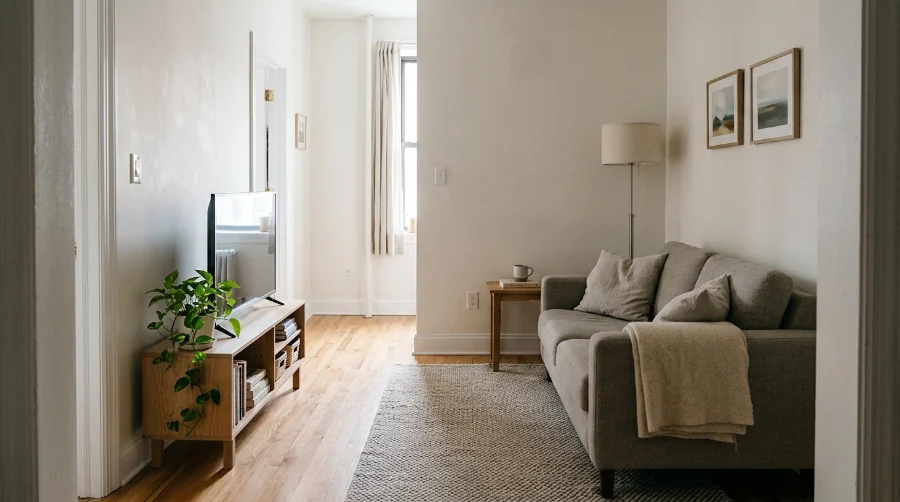
The route through a small living room rarely runs straight from door to sofa. It usually cuts diagonally past the window and around the seating. When the television is moved to solve glare, check that the new position does not push a chair into that route.
Leave space in front of the screen for people to pass without walking between a seated viewer and the television. A gap in front of the sofa is more useful than a little extra room behind it, since most traffic crosses the viewing side of the furniture.
Cables from the television should follow the wall or the back of the unit rather than crossing the floor. A shallow channel along the skirting keeps leads tidy and removes a trip hazard in a room where people already navigate around furniture.
Some rooms genuinely lack a good position. A window on two adjacent walls, a radiator on the third and a doorway on the fourth leave few options. In that situation, accept that the television will not be the room's only focus and plan around flexibility instead.
A lighter, movable screen on a stand can be brought out for viewing and stored to one side afterwards. A mount on a short arm allows the screen to turn toward different seats. Both solutions suit rooms where the window and the view matter as much as the television.
It also helps to rethink which wall the sofa faces. Turning the main seat toward the window and treating the television as a secondary option can make a small room feel calmer, particularly when the household watches less television than it used to. The best layout is the one that matches how the room is actually used, not the one that gives the screen the most prominent wall.
The conflict between a television and a window is a question of light and movement. Work out when the glare arrives, try the side and opposite walls before the obvious one, and keep a clear route through the room. When those decisions are made in the right order, the furniture tends to fall into place behind them.
Guides that pair well with this one.
Some living rooms have two things that both want to be the center: a fireplace and a television, or a window with a view and a fireplace. Furniture cannot face two…
A fireplace naturally draws the eye, but that does not mean every piece of furniture should point at it. The room still has to work for conversation, walking and…
The sofa is usually the largest single object in a small room, so its position decides how everything else fits. Move it a few inches and a walkway opens or closes…